WhatsApp Is Bringing Third-Party AI Agents Into Chats: Here’s How It Works
 By Inflix
 WhatsApp Is Bringing Third-Party AI Agents Into Chats: Here’s How It Works
What if WhatsApp became more than a messaging app and let you talk directly to your own AI agents?
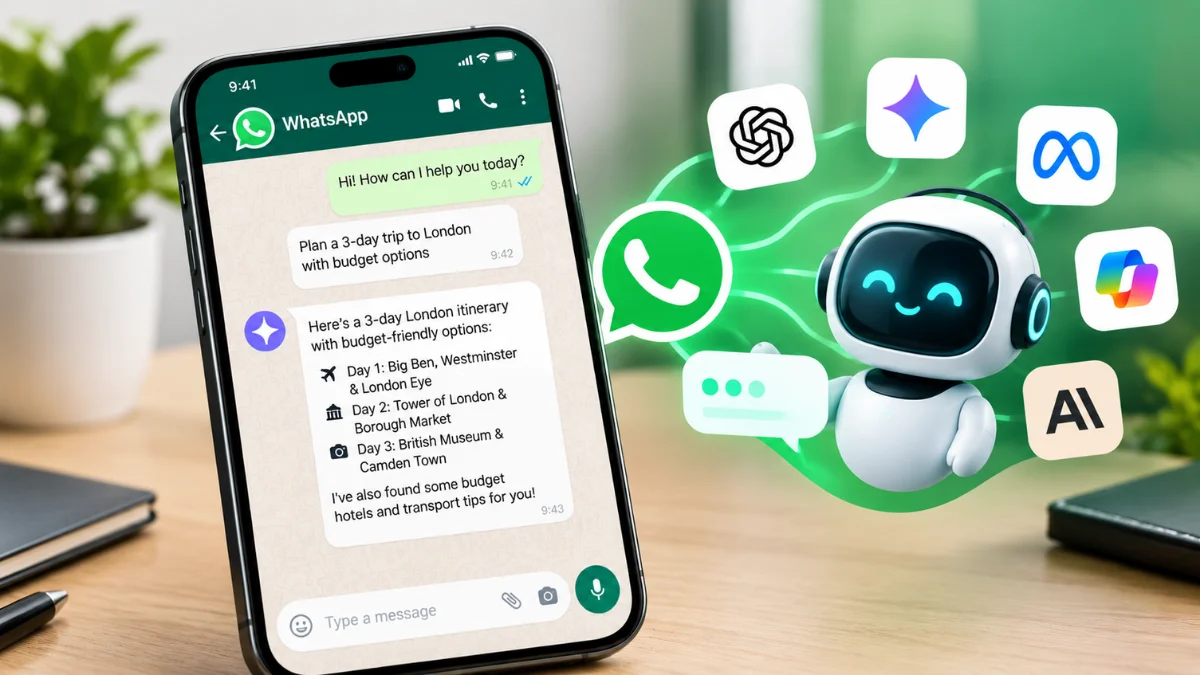
WhatsApp is rolling out support for third-party AI agents, allowing selected users to connect external AI services and communicate with them through dedicated conversations inside the app. Instead of constantly switching between WhatsApp and another AI platform, users can send instructions to a connected agent much like they would send a normal message.
The new WhatsApp third-party AI agents feature is currently reaching a limited number of users, with Android at the centre of the early rollout. However, there is an important privacy difference users need to understand before connecting an external AI service: conversations with third-party agents are not considered end-to-end encrypted in the same way as ordinary personal WhatsApp chats.
What Are WhatsApp Third-Party AI Agents?
WhatsApp third-party AI agents are external automated services that users can connect to their WhatsApp accounts. These agents may use artificial intelligence, although the system can also support other types of automated bots.
An AI agent goes beyond the basic idea of a scripted chatbot. Depending on the service behind it, an agent can understand natural-language instructions, provide information and potentially perform more complex tasks on behalf of the user.
WhatsApp essentially provides the conversation interface. The external developer or company remains responsible for building and operating the third-party agent.
This marks another major step in Meta’s wider push to bring artificial intelligence into its messaging ecosystem. MobileVerse readers can also explore our WhatsApp AI features and updates coverage to see how AI is already changing the messaging platform.
How Do Third-Party AI Agents Work on WhatsApp?
The process is designed around a dedicated WhatsApp conversation for each connected agent. Users with access can configure an agent, give it a recognisable name and profile image, and then connect it to the external service that operates it.
During the connection process, WhatsApp can generate an API key. The user then provides that key to the compatible third-party agent platform, allowing the external service to communicate through the dedicated WhatsApp conversation.
Once connected, the experience should feel familiar. Users can open the agent’s conversation, send an instruction and receive the response directly inside WhatsApp without moving to a separate app.
The exact capabilities will depend on the third-party service. WhatsApp provides the communication channel, but it does not make every connected agent capable of performing the same tasks.
WhatsApp Could Support Up to Five Third-Party Agents
Early rollout information indicates that WhatsApp can support up to five third-party agents connected to one account.
Each agent gets its own dedicated conversation. This approach could allow someone to use different agents for different purposes rather than relying on a single general-purpose AI assistant.
For example, one compatible agent might focus on productivity while another could provide a specialised automated service. However, the actual capabilities depend entirely on the developer and platform operating each agent.
Users should therefore avoid assuming that every WhatsApp AI agent will have the same functionality.
Can WhatsApp AI Agents Read Your Other Chats?
This is one of the most important questions surrounding the feature, and the answer is reassuring but requires some context.
According to WhatsApp, a third-party agent can access only the information you share with that agent. It cannot simply open and read your unrelated personal WhatsApp conversations.
Current implementation details also indicate that connected agents cannot access your other conversations, contact list or media stored in unrelated chats. The agent operates inside its own dedicated conversation rather than receiving unrestricted access to your WhatsApp account.
This separation is important because giving an external AI service unrestricted access to someone’s messaging account would create serious privacy concerns.
Users should still be careful about what they deliberately send to an AI agent because information shared directly in the agent conversation is available to the external service operating that agent.
Are WhatsApp Third-Party AI Agent Chats End-to-End Encrypted?
This is the biggest privacy warning users should understand.
Normal personal WhatsApp messages use end-to-end encryption, which is one of the platform’s most important security features. However, WhatsApp says conversations with third-party agents are not considered end-to-end encrypted.
WhatsApp explains that messages still use its Signal encryption protocol before leaving the user’s device and are delivered securely to the destination chosen by the agent. However, a secure Meta service manages these conversations on behalf of the third-party agent.
Because the messages are not travelling directly between devices controlled by the people sending and receiving them, WhatsApp does not classify these agent conversations as end-to-end encrypted.
That distinction matters. Users should treat a conversation with an external AI agent differently from a private conversation with a friend or family member. For more information about protecting conversations on the platform, readers can explore our WhatsApp privacy and security updates coverage.
What Information Should You Avoid Sharing With an AI Agent?
The safest approach is to treat a third-party AI conversation like any other interaction with an external online service.
Avoid sending passwords, banking details, private authentication codes or other highly sensitive information unless you completely understand how the particular service processes and protects that data. The fact that an agent appears inside WhatsApp does not mean WhatsApp itself operates that AI service.
Users should also check the privacy policy of the company or developer behind an agent before sharing personal information. Different AI providers may have different rules regarding data storage, model training and account information.
This distinction could become increasingly important as WhatsApp opens its platform to more external AI services.
Can Third-Party Agents Join WhatsApp Groups?
Not currently.
The early implementation keeps third-party agents inside individual conversations. Current reporting indicates that users cannot add these external agents to group chats or WhatsApp Communities.
That limitation makes sense during an early rollout because group access would create additional privacy and permission questions. An agent inside a large group could potentially receive messages from people who never personally chose to interact with that AI service.
Keeping agents in separate one-to-one conversations gives users greater control over exactly what information they send.
Are Third-Party Agents the Same as Meta AI?
No. This distinction is important.
Meta AI is developed by WhatsApp’s parent company, Meta. Third-party AI agents are created and operated by external developers or companies.
WhatsApp provides the platform that lets these external services communicate with users, but the third party remains responsible for the agent itself. That means its capabilities, privacy practices and data handling may differ from Meta AI.
The arrival of external agents therefore represents a significant expansion of WhatsApp’s AI strategy. Instead of offering only Meta’s own assistant, the messaging platform is beginning to create space for outside AI services as well.
Readers interested in how artificial intelligence is changing mobile software can also explore our latest artificial intelligence news.
Why Is WhatsApp Adding Third-Party AI Agents?
AI agents are becoming a larger part of the technology industry. Instead of simply answering questions, companies are developing systems that can follow instructions and interact with digital services on behalf of users.
Messaging apps are a natural interface for these systems because people already understand how to communicate through chat. Asking an AI agent to perform a task can feel much more intuitive when the interaction resembles sending a message to another contact.
WhatsApp also has another reason to explore this model. Users interested in remote AI agents have previously turned to other messaging platforms or unofficial WhatsApp integrations to communicate with automated services.
Native third-party agent support gives WhatsApp a controlled way to bring that behaviour directly into its own platform.
Could WhatsApp Become an AI Agent Hub?
The feature could eventually change how people think about WhatsApp.
Today, most people open the app primarily to communicate with friends, family, colleagues and businesses. In the future, a WhatsApp chat list could also contain several specialised AI agents alongside human contacts. One agent might help organise tasks, another might interact with a particular online service, while another could provide specialised information. Instead of opening multiple AI apps, users could potentially access different assistants from one familiar interface.
However, much depends on which developers support the feature and what WhatsApp eventually allows connected agents to do. The current rollout remains limited, so it is too early to know whether third-party agents will become a mainstream part of the platform.
Can WhatsApp AI Agents Make Mistakes?
Yes. Users should not assume that an AI response is correct simply because the agent is available through WhatsApp.
WhatsApp itself warns that generative AI can produce inaccurate or inappropriate responses. The same general limitation applies to third-party AI systems, which can misunderstand requests, generate incorrect information or make mistakes while processing instructions.
Users should double-check important information, particularly when it relates to money, travel, work, legal matters or other decisions where an incorrect answer could have consequences.
The WhatsApp interface may make interacting with an AI agent feel like a normal conversation, but the technology behind that chat still has the limitations associated with generative AI.
How Do You Remove a Third-Party Agent From WhatsApp?
Users can manage connected agents through WhatsApp’s settings. If an agent is no longer needed, it can be disconnected from the account.
Current rollout information indicates that disconnecting an agent does not automatically erase the existing conversation from the chat list. If users later want to reconnect the same service, they may need to establish a new connection. This gives users control over which external services remain connected to their WhatsApp account. As the feature expands, WhatsApp may refine these controls further based on feedback from early users.
Who Can Use WhatsApp Third-Party AI Agents Right Now?
The feature is not available to everyone. WhatsApp began testing the functionality with a very limited number of users in selected countries, with WhatsApp beta for Android 2.26.35.3 identified as a compatible version during the early rollout.

Even installing the compatible beta does not necessarily guarantee access because WhatsApp frequently activates experimental features on a server-side basis for selected accounts. There is currently no confirmed date for when every Android user will receive the feature, and wider availability could depend on how the initial testing progresses. Users therefore should not worry if they cannot see an option for third-party agents in WhatsApp settings yet.
What Does This Mean for WhatsApp Users?
WhatsApp third-party AI agents could make external AI tools considerably easier to access. Instead of learning a new interface or constantly switching between apps, users could communicate with compatible services through the same chat interface they already use every day.
The privacy trade-off deserves equal attention. Personal WhatsApp conversations remain protected separately, but messages deliberately sent to a third-party agent follow different rules and are not considered end-to-end encrypted. Users should therefore think carefully about which agents they connect and what information they share with them.
For people already using AI assistants regularly, the feature could make WhatsApp a much more powerful productivity platform. For everyone else, its value will depend on whether developers create agents that solve genuinely useful everyday problems.
WhatsApp Third-Party AI Agents: Final Thoughts
WhatsApp third-party AI agents represent a bigger change than simply adding another chatbot to the app. The feature opens WhatsApp to external AI services and gives users a familiar interface for communicating with automated agents without constantly moving between different applications.
The early implementation also includes sensible boundaries. Third-party agents remain inside dedicated conversations and cannot freely access unrelated chats, contacts or media. However, users need to understand that these agent conversations are not considered end-to-end encrypted like ordinary personal WhatsApp chats.
For now, availability remains limited, particularly among selected Android users. If WhatsApp expands the feature globally and major AI platforms adopt it, the messaging app could gradually evolve from a place for human conversations into a broader hub for people, businesses and AI agents.
Frequently Asked Questions
What are WhatsApp third-party AI agents?
They are external automated services created by developers or companies that users can connect to WhatsApp. Once connected, users can communicate with the agent through its own dedicated conversation inside the app.
Can third-party AI agents read my WhatsApp messages?
A connected agent can access information that you deliberately share in its dedicated conversation. WhatsApp says third-party agents cannot automatically access your unrelated personal conversations.
Are WhatsApp AI agent chats end-to-end encrypted?
WhatsApp does not consider conversations with third-party agents end-to-end encrypted because a Meta-managed service handles the messages on behalf of the external agent.
How many third-party AI agents can I add?
Current rollout information indicates that WhatsApp supports connecting up to five third-party agents to an account.
Can I add an AI agent to a WhatsApp group?
Not under the current implementation. Third-party agents operate through individual dedicated conversations and cannot currently join group chats or Communities.
Is a third-party AI agent the same as Meta AI?
No. Meta develops Meta AI, while independent companies or developers create third-party agents. WhatsApp provides the communication platform but does not operate every external agent.
When will WhatsApp third-party AI agents be available to everyone?
WhatsApp has not announced a confirmed global release date. The feature is currently available to a limited number of users, with early access appearing on Android.