
Microsoft Sets New AI Privacy Rules for Schools: What Students and Parents Need to Know
 By Inflix
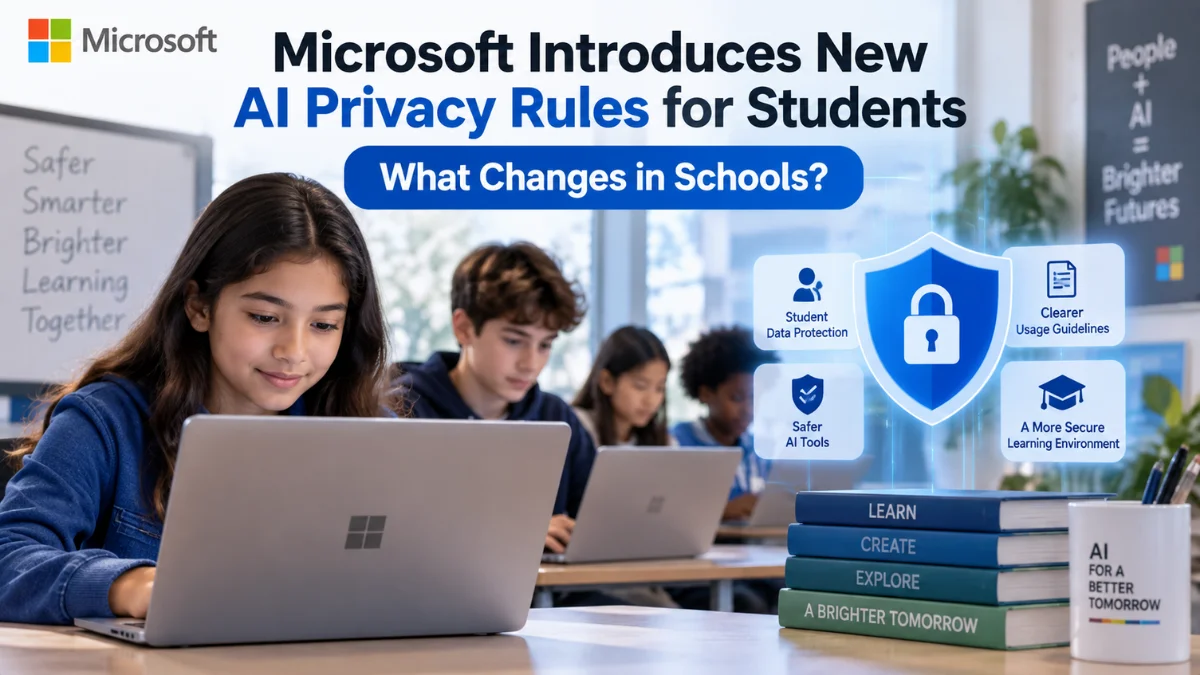
 Microsoft AI privacy rules are introducing stronger protections for students, teachers and families as artificial intelligence becomes more common in education. Microsoft has reached an agreement with major US teachers’ unions that establishes legally enforceable safeguards governing how AI tools handle school data.
The agreement could become particularly important because schools increasingly use AI for studying, lesson preparation, research and administrative tasks. Microsoft itself says AI use is already widespread across education.
For students and parents, however, the most significant part of the announcement is simple: companies covered by the agreement cannot freely turn school data into material for training their AI systems.
Microsoft AI Privacy Rules: What Is Changing in Schools?
Microsoft developed the National AI Safety & Privacy Standard with the American Federation of Teachers (AFT) and United Federation of Teachers (UFT).
The agreement establishes rules for artificial intelligence products used within participating educational environments.
According to Microsoft, the standard requires protections around student data, transparency and human oversight. It also establishes limits on how companies can interact with students through AI-powered systems.
| Protection | What It Means |
|---|---|
| AI training | Companies cannot use student data to train AI models |
| Advertising | Student and educator information cannot fuel targeted advertising |
| Tracking | Companies cannot track students for unrelated purposes |
| Human oversight | AI cannot independently make certain important decisions |
| Transparency | Schools and families should receive clearer information about AI tools |
| Auditing | AI systems face additional accountability requirements |
These measures aim to give schools greater control before they introduce artificial intelligence into everyday learning.
Student Data Cannot Be Used to Train AI
One of the biggest changes concerns AI training.
Under the agreement, Microsoft cannot use student or educator data to train AI models, develop products or support advertising, apart from limited exceptions covered by the standard.
That distinction matters because students may enter significant amounts of information into educational AI systems.
A student might ask an AI assistant to review an assignment, explain a difficult subject or work with uploaded learning materials. Teachers could similarly use AI to prepare lessons or organise educational content.
The new standard aims to prevent companies from treating that information as freely available training material.
Microsoft already states that content and conversations within its Study and Learn Agent do not train the underlying foundation models.
Microsoft AI Privacy Rules Also Limit Student Tracking
The standard goes beyond AI model training.
Microsoft says students cannot be tracked under the agreement, while companies must provide educators and parents with understandable information explaining how their technology works.
That could become increasingly important as educational software grows more personalised.
AI systems can potentially analyse how someone learns, which questions they struggle with and how they interact with digital content. Such information can improve learning experiences, but it also creates legitimate privacy concerns.
Stronger AI student privacy protections therefore provide a clearer boundary between educational personalisation and unnecessary data collection.
AI Cannot Simply Replace Human Decisions
Another important element involves human oversight.
The agreement says AI cannot make decisions without human oversight in circumstances covered by the standard.
This principle matters in education because automated systems could eventually influence assessments, recommendations or other decisions affecting students.
AI may help teachers analyse information, but the standard attempts to preserve human responsibility rather than handing complete authority to an algorithm.
For readers following Mobile Verse artificial intelligence news, this reflects a wider shift in the technology industry. The debate is moving beyond what generative AI can do towards how companies should control increasingly powerful systems.
What About Emotionally Manipulative AI?
The agreement also addresses how AI communicates with young users.
Associated Press reports that the protections prohibit emotionally manipulative AI features.
This is particularly relevant for children and teenagers, who may interact with conversational AI differently from adults.
An educational chatbot should help someone learn rather than deliberately encourage emotional dependence or manipulate the user into continuing an interaction.
These restrictions show that AI safety for students now involves more than protecting passwords and personal information. Developers increasingly need to consider how AI behaves during conversations.

When Do the New Rules Take Effect?
The standards are scheduled to become effective on 1 November 2026.
That gives Microsoft and participating educational organisations time to prepare for implementation.
However, the announcement should not be interpreted as a universal law governing every AI service or every school worldwide.
The agreement specifically involves Microsoft and the participating US teachers’ unions. Broader protection will depend on whether other technology companies adopt similar commitments and whether governments introduce additional regulation.
Will Google, OpenAI and Anthropic Follow Microsoft?
That is now one of the biggest questions.
Associated Press reports that OpenAI and Anthropic have been negotiating with the AFT and responded positively to Microsoft’s agreement. Google, another major provider of educational technology, had not made the same commitment at the time of the report.
If additional companies sign similar agreements, Microsoft’s decision could help establish a wider industry standard.
That would matter because schools rarely depend on only one technology company. Students may use products from Microsoft, Google, OpenAI and other providers during the same academic year.
Privacy standards become more effective when protections remain consistent across those services.
Why AI Privacy in Schools Is Becoming More Important
AI has quickly moved from an experimental classroom technology to something many students and educators already use.
Microsoft reported earlier this year that 92% of surveyed students and education leaders and 88% of surveyed educators had used AI for school-related purposes.
That rapid adoption creates opportunities.
AI can explain concepts, generate practice exercises, help educators prepare material and provide personalised learning assistance. Microsoft, for example, offers its Study and Learn Agent to help students understand concepts and practise through activities such as quizzes and flashcards.
However, increased usage also means more educational information potentially flows through AI systems.
Therefore, student data privacy is becoming just as important as the capabilities of the AI itself.
What Do the Microsoft AI Privacy Rules Mean for Parents?
Parents should gain greater visibility into how educational AI products operate.
The agreement requires companies to provide clearer explanations about their tools rather than expecting families to understand complicated technical privacy policies.
That could make it easier for parents to understand what information an AI tool collects and what happens when their child uses it.
Schools still need their own responsible technology policies, though. An industry agreement cannot replace appropriate supervision, cybersecurity practices and digital literacy education.
How Microsoft AI Privacy Rules Protect Students
For students, the most important benefit is greater separation between learning activity and commercial AI development.
The Microsoft AI privacy rules aim to prevent educational information from automatically becoming training data or advertising material.
Students should remain careful about entering highly sensitive personal information into any online service. Privacy safeguards reduce risk, but they do not eliminate the need for responsible digital behaviour.
As AI becomes a routine learning tool, understanding how to use it safely could become an essential digital skill alongside knowing how to search the web or protect an online account.
Could Microsoft’s Agreement Influence the Wider AI Industry?
Potentially.
Microsoft is one of the world’s largest technology companies and already provides software to schools and universities around the world. A formal privacy agreement therefore puts additional pressure on competitors to explain their own protections.
However, meaningful industry-wide change would require broader adoption.
If Microsoft follows one standard while every other AI provider follows different rules, schools still face a complicated privacy environment.
The bigger story may therefore develop over the coming months as OpenAI, Anthropic, Google and other AI companies decide whether to introduce comparable commitments.
Readers interested in how artificial intelligence is changing everyday technology can explore Mobile Verse AI coverage for our latest reports on new AI tools, privacy developments and major platform changes.
You can also connect this article naturally with your existing ChatGPT developments, Claude AI news and other relevant AI/privacy posts rather than linking the exact focus keyphrase.
FAQs
What are the new Microsoft AI privacy rules?
The new standard establishes protections covering student and educator data when Microsoft AI products operate in participating educational environments. The measures address AI training, tracking, transparency and human oversight.
Can Microsoft use student data to train AI?
The new agreement prevents Microsoft from using student or educator data for AI training under the standard, subject to its specified limited exceptions.
When will Microsoft’s school AI privacy standard start?
The protections are scheduled to take effect on 1 November 2026.
Do the rules apply to ChatGPT and Google Gemini?
Not automatically. This agreement concerns Microsoft. OpenAI and Anthropic have been in discussions with the AFT, while Google had not made the same commitment when AP reported on the agreement.
Why does AI privacy matter for students?
Students increasingly use AI for learning, assignments and research. Privacy safeguards can help prevent educational information from being unnecessarily used for AI training, advertising or tracking.
Final Thoughts
The Microsoft AI privacy rules show how the conversation around educational AI is changing. Schools no longer need to consider only whether AI improves learning; they also need clear answers about what happens to student information.
Microsoft’s agreement establishes significant safeguards around training data, tracking, transparency and human oversight. If other major AI companies introduce comparable protections, the agreement could help push student privacy towards becoming a standard requirement rather than an optional feature.
