OnePlus 16 Leak Reveals 165Hz Display and Ultra-Thin Bezels
 By Inflix
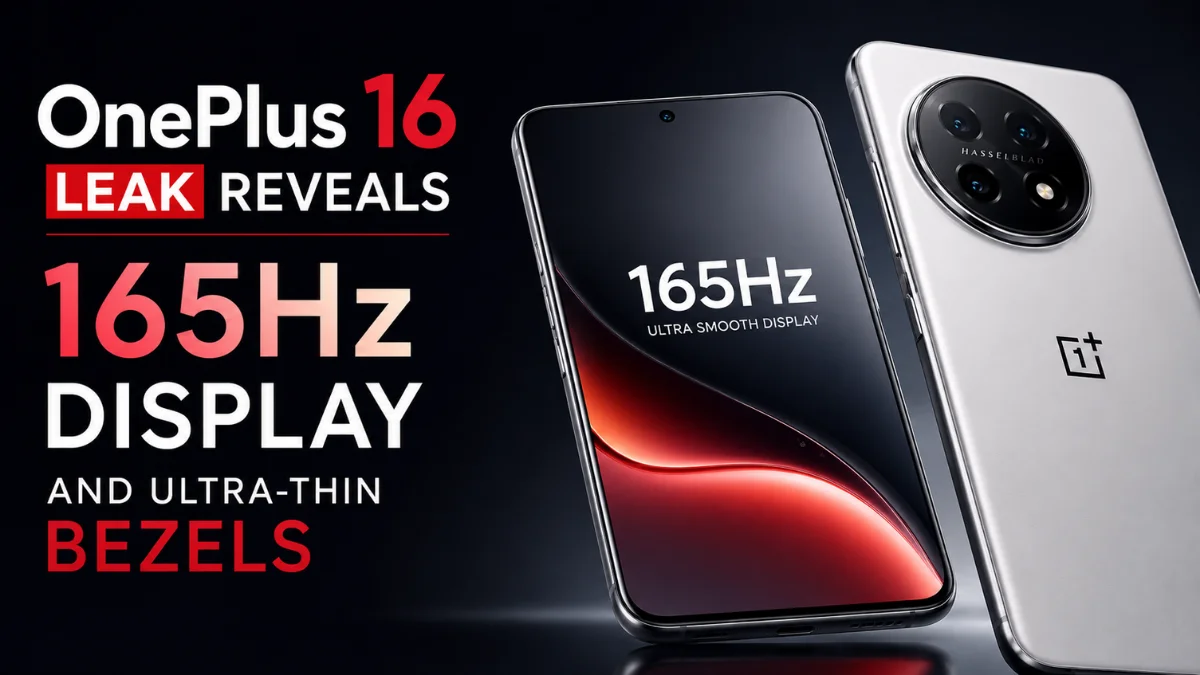
 The OnePlus 16 display leak points to one of the phone’s biggest upgrades yet, with a custom 165Hz screen and extremely thin bezels reportedly planned for the upcoming flagship.
The OnePlus 16 is reportedly being developed with a custom 165Hz display and some of the narrowest four-sided bezels yet seen on a OnePlus flagship. If the leak proves accurate, OnePlus could focus heavily on display fluidity and gaming performance when its next premium phone arrives.
However, OnePlus has not officially confirmed these specifications. Therefore, the current information should be treated as an early look at the company’s possible plans rather than final hardware.
OnePlus 16 Display Leak Points to a Custom 165Hz Screen
The latest report claims that OnePlus is developing a custom display panel capable of reaching 165Hz.
Most current flagship smartphones use 120Hz displays. Moving to 165Hz would therefore give the OnePlus 16 a significantly higher maximum refresh rate.
The interesting part isn’t simply the number.
According to the leak, the higher refresh rate could work across more of the system rather than being restricted to a small number of supported games or scenarios.
If OnePlus implements it well, animations, scrolling and supported games could feel exceptionally smooth.
The OnePlus 16 display leak therefore suggests that screen performance could become one of the biggest selling points of the upcoming flagship.
What Does a 165Hz Display Actually Mean?
A display’s refresh rate describes how many times it can update the image every second.
A 60Hz screen can refresh up to 60 times per second.
At 120Hz, that figure doubles.
A 165Hz display can potentially refresh 165 times every second.
| Refresh rate | Maximum screen updates |
|---|---|
| 60Hz | 60 per second |
| 90Hz | 90 per second |
| 120Hz | 120 per second |
| 144Hz | 144 per second |
| 165Hz | 165 per second |
Higher numbers can make motion look smoother, but there is an important catch.
The phone also needs enough processing power to produce content at those frame rates.
Why the OnePlus 16 Display Could Be Better for Gaming
Gaming is where a OnePlus 16 165Hz display could make the strongest argument for itself.
Competitive games benefit from high frame rates because movement appears smoother and controls can feel more responsive.
However, a 165Hz screen doesn’t automatically mean every game will run at 165fps.
Games need to support higher frame rates, while the processor and GPU must be powerful enough to maintain them.
Therefore, OnePlus will need strong partnerships and software optimisation if it wants 165Hz to become more than a specification-sheet headline.
What the OnePlus 16 Display Leak Says About Thin Bezels
Refresh rate isn’t the only interesting display detail.
The latest leak also points towards extremely narrow bezels on all four sides of the screen.
Reducing the border around a display allows manufacturers to create a more immersive front design without dramatically increasing the overall dimensions of the phone.
Uniform bezels can also make a device look more refined.
For OnePlus, this could mean the OnePlus 16 feels noticeably more modern even if the basic rectangular smartphone shape remains familiar.
Why Equal Four-Sided Bezels Matter
Many smartphones claim to have thin bezels, yet the bottom border can still be slightly thicker than the sides.
Achieving consistently narrow borders around all four edges is more difficult.
If OnePlus manages it, the display could appear almost edge-to-edge when viewed from the front.
That would particularly benefit:
- Video streaming
- Mobile gaming
- Photo viewing
- Reading
- Web browsing
The improvement is primarily visual, but premium smartphone design increasingly depends on these small details.
OnePlus 16 Could Target Serious Mobile Gaming
A 165Hz display would make much more sense if OnePlus builds the rest of the phone around performance.
Previous reports have already suggested that the OnePlus 16 could use a next-generation Snapdragon 8 Elite-series processor.
That combination could give OnePlus a strong gaming story:
High refresh rate + flagship processor + large battery.
Still, sustained performance matters more than short benchmark bursts.
OnePlus would need an effective cooling system to prevent heat from reducing CPU and GPU performance during longer gaming sessions.

OnePlus 16 Display and Battery Could Work Together
Perhaps the most surprising earlier OnePlus 16 rumour involves battery capacity.
Reports have linked the phone with a battery of around 9,000mAh.
For context, many mainstream flagship phones have traditionally remained around the 5,000mAh range.
A battery approaching 9,000mAh could dramatically change expectations for flagship endurance.
It could also make a 165Hz display more practical.
Higher refresh rates can consume additional power, particularly when the screen operates at its maximum frequency for extended periods.
A much larger battery could help offset that demand.
But Battery Capacity Doesn’t Tell the Whole Story
A 9,000mAh number sounds impressive, but real-world battery life depends on several factors.
These include:
- Display efficiency
- Processor efficiency
- Software optimisation
- Mobile network usage
- Camera activity
- Gaming workload
- Screen brightness
OnePlus would also need to keep the phone reasonably thin and light.
Modern silicon-carbon battery technology has allowed manufacturers to increase capacity without making phones proportionally thicker, which may help explain how such a large battery could become possible.
Still, the 9,000mAh figure remains unconfirmed.
A 200MP Camera Could Be Another Major Upgrade
The OnePlus 16 has also been linked with a 200MP camera.
That would represent another aggressive specification if it reaches the final device.
However, megapixels alone don’t determine camera quality.
Sensor size, lenses, optical image stabilisation and computational photography all play major roles.
A well-optimised 50MP camera can outperform a poorly implemented 200MP system.
Therefore, the more important question will be how OnePlus uses the sensor rather than simply how many pixels it contains.
OnePlus 16 Rumoured Specifications So Far
The early picture looks ambitious.
| Feature | Current report |
|---|---|
| Display | Custom panel |
| Refresh rate | Up to 165Hz |
| Bezels | Ultra-thin on four sides |
| Processor | Next-gen Snapdragon flagship chip expected |
| Battery | Around 9,000mAh rumoured |
| Main camera | 200MP rumoured |
| China launch | October expected |
| Officially confirmed | No |
These specifications come from pre-launch reports, so the final retail phone could differ.
Could the OnePlus 16 165Hz Display Beat 120Hz Screens?
Technically, yes.
Practically, the answer is more complicated.
The jump from 60Hz to 120Hz is easy for many users to notice. Moving from 120Hz to 165Hz produces a smaller perceptual improvement.
Mobile gamers are more likely to appreciate the difference than someone primarily using WhatsApp, Chrome and YouTube.
There is also battery consumption to consider.
The best implementation would allow the OnePlus 16 to dynamically reduce its refresh rate when 165Hz isn’t needed.
That could provide maximum smoothness during gaming while preserving battery life during static activities such as reading.
Why the OnePlus 16 Display Leak Matters
Android flagship hardware has become extremely competitive.
Processors are already remarkably fast. Cameras have improved dramatically, and charging speeds have reached levels that would have seemed excessive only a few years ago.
That makes differentiation harder.
A custom 165Hz panel could give OnePlus a straightforward marketing advantage, particularly among performance-focused users.
Instead of saying the display is simply “better”, OnePlus could position the phone around a measurable gaming and smoothness advantage.
Whether users actually need it is another question.
OnePlus 16 Display Leak: When Could the Phone Launch?
Current reporting suggests the OnePlus 16 could launch in China in October 2026.
Global availability may follow later.
OnePlus has not officially confirmed the launch schedule, so exact dates should remain tentative.
As October approaches, certification databases, official teasers and additional leaks should give us a clearer picture.
Rather than creating separate articles for every small leak, the most useful approach will be to update this story when meaningful new information becomes available.
As the expected launch approaches, the OnePlus 16 display leak gives us an early indication of how OnePlus plans to differentiate its next premium phone.
Should You Wait for the OnePlus 16?
If you’re already considering a premium OnePlus upgrade, the early leaks provide a good reason to wait for more information.
The combination of a 165Hz display, extremely narrow bezels, huge battery and flagship Snapdragon hardware could make the OnePlus 16 particularly attractive to gamers and power users.
However, none of those headline specifications matters if the phone becomes too expensive, heavy or difficult to keep cool.
Official pricing will therefore be crucial.
What OnePlus Still Needs to Confirm
Several major questions remain unanswered.
We still need to know the final:
- Display size and resolution
- Processor
- Battery capacity
- Charging speeds
- Camera configuration
- IP rating
- Software support period
- Global launch date
- UK pricing
Until OnePlus confirms those details, buyers should treat the current specifications as an early preview rather than a finished product sheet.

Final Verdict
The OnePlus 16 is beginning to look like a flagship built around excess — and that could make it interesting.
A 165Hz custom display would push beyond the 120Hz screens found on many premium phones, while ultra-thin four-sided bezels could give the device a cleaner and more immersive appearance.
Then there are the earlier rumours of a 9,000mAh battery and 200MP camera.
If even most of those specifications prove accurate, OnePlus could be preparing a serious performance-focused flagship rather than a minor annual upgrade.
For now, though, the 165Hz display remains a leak.
The real test will come when OnePlus explains how its new screen improves everyday use without sacrificing battery life.
The OnePlus 16 could arrive during one of the busiest Android flagship cycles of the year. Mobile Verse readers interested in next-generation performance can also explore our Vivo X500 Pro Max benchmark leak, which reveals another upcoming flagship processor and Android 17 hardware. Our Motorola Android 17 update guide explains the latest software changes arriving on competing Android devices, while the Android 17 hidden features guide covers Google’s broader improvements that could influence upcoming flagship phones.
Frequently Asked Questions
Will the OnePlus 16 have a 165Hz display?
A new leak claims that the OnePlus 16 will use a custom display capable of reaching 165Hz. OnePlus has not officially confirmed the specification yet.
What is special about the OnePlus 16 display?
Alongside the reported 165Hz refresh rate, the phone is tipped to feature extremely narrow bezels on all four sides of the display.
Will the OnePlus 16 have a 9,000mAh battery?
Earlier reports have linked the phone with a battery around 9,000mAh. However, this remains a rumoured specification until OnePlus confirms it.
Will the OnePlus 16 have a 200MP camera?
Current leaks point towards a possible 200MP camera. The final camera configuration has not yet been announced.
Is 165Hz better than 120Hz?
A 165Hz display can refresh more frequently and may produce smoother motion. The difference will be most useful in supported high-frame-rate games, while everyday users may notice a smaller improvement.
When will the OnePlus 16 launch?
Current reporting points towards a China launch around October 2026, but OnePlus has not officially announced the launch date.