
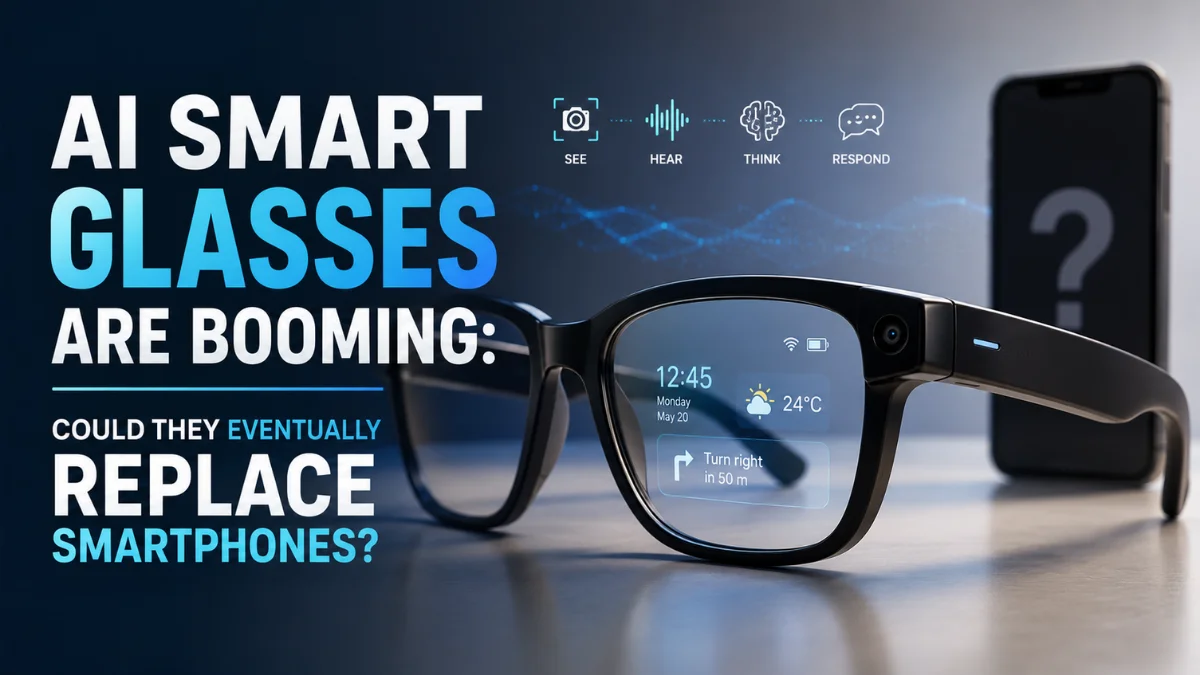
AI Smart Glasses Are Booming: Could They Eventually Replace Smartphones?
 By Inflix
 AI smart glasses are rapidly moving from an experimental gadget to one of the most closely watched categories in consumer technology.
For years, technology companies have searched for the device that might eventually reduce our dependence on smartphones. Smartwatches made some progress, while virtual reality headsets created entirely new experiences. However, neither has replaced the phone in our pockets.
Now, AI smart glasses are emerging as another serious contender.
Meta has built strong momentum with its smart-glasses ecosystem, while Google, Samsung and other companies are investing in next-generation wearable computing. At the same time, artificial intelligence is making glasses considerably more useful than earlier attempts such as Google Glass.
So, could AI glasses really become the next major computing platform — and might they eventually replace smartphones?
AI Smart Glasses Are Growing Quickly
The smart-glasses market is no longer a tiny experiment.
Counterpoint Research reports that global intelligent-eyewear shipments grew 83% year over year during Q1 2026. More specifically, display-less smart glasses recorded an impressive 210% increase.
Meanwhile, Meta held an estimated 84% share of the global display-less smart-glasses market during the quarter.
That growth suggests consumers are becoming increasingly comfortable with wearable devices that look much more like ordinary glasses.
| Smart Glasses Market Indicator | Latest Figure |
|---|---|
| Intelligent eyewear growth in Q1 2026 | 83% YoY |
| Display-less smart glasses growth | 210% YoY |
| AR glasses growth | 136% YoY |
| Meta share of display-less smart glasses | 84% |
| AI glasses share of smart-glasses shipments in H2 2025 | 88% |
The numbers also explain why so many major technology companies are paying attention to this category.
What Are AI Smart Glasses?
AI smart glasses combine traditional eyewear with technology such as cameras, microphones, speakers, wireless connectivity and artificial intelligence.
Some models do not include a display at all. Instead, users interact with an AI assistant through voice commands and receive audio responses through built-in speakers.
More advanced AR models can place information directly within the wearer’s field of view.
Depending on the device, AI glasses can potentially:
- Take photos and videos
- Answer questions about your surroundings
- Play music
- Make calls
- Send messages
- Provide directions
- Translate conversations
- Identify objects
- Read text
- Give AI-powered assistance
The biggest advantage is simple: you do not always need to take your phone out of your pocket.
Why AI Has Changed the Smart Glasses Story
Smart glasses are not a completely new idea.
Google introduced Google Glass more than a decade ago. Although it attracted enormous attention, the consumer version never achieved mainstream success.
Today’s devices have one major advantage that early smart glasses lacked: generative AI.
An AI assistant can use cameras and microphones to understand what the wearer sees and hears.
Imagine looking at a building and simply asking:
“What is this place?”
Or looking at a restaurant menu and asking:
“Which of these dishes is vegetarian?”
Similarly, glasses could translate a sign, remember where you parked or provide directions without forcing you to stare at a phone.
This contextual assistance is what makes modern AI glasses fundamentally more interesting than simply putting a camera into a pair of spectacles.
Meta Currently Leads the Smart Glasses Race
Meta has emerged as the strongest player in the current consumer smart-glasses market.
Its partnership with eyewear specialist EssilorLuxottica has helped it create devices that resemble normal Ray-Ban and Oakley glasses rather than bulky technology products.
That design advantage matters.
People may tolerate a large VR headset at home. However, a device designed for everyday wear needs to look and feel like something people actually want on their faces.
Meta’s market position reflects that strategy.
Counterpoint says Meta controlled 84% of the display-less smart-glasses segment in Q1 2026.
Furthermore, AI-enabled glasses accounted for 88% of total smart-glasses shipments during the second half of 2025.
That suggests artificial intelligence has quickly become central to the category rather than an optional extra.
Google Is Bringing Gemini to Smart Glasses
Meta will not have the market to itself.
Google has already outlined an ambitious plan for Android XR smart glasses powered by Gemini.
The company is developing two main categories.
The first consists of audio glasses, which provide spoken AI assistance without placing a screen in front of the user’s eyes.
The second consists of display glasses, which can show useful information directly within the lenses.
Google says users will be able to perform tasks such as getting directions, sending messages and taking photos without constantly reaching for a smartphone.
Even more importantly, Gemini can use the glasses’ camera and microphones to understand the wearer’s surroundings.
Google Is Working With Samsung and Eyewear Brands
Google is not developing this ecosystem alone.
Android XR was created with Samsung and Qualcomm, while Google has also announced eyewear partnerships with Warby Parker and Gentle Monster.
Google says its first audio glasses are expected to arrive in autumn 2026.
This approach could become particularly important.
Rather than producing only one pair of Google-branded glasses, Android XR could eventually become a platform that multiple manufacturers use — similar to what Android achieved with smartphones.
That could give consumers a much wider selection of designs and price points.

Why Samsung Matters
Samsung’s involvement gives the Android XR ecosystem additional weight.
The company has already entered the extended-reality market with Galaxy XR, the first headset built around Google’s Android XR platform.
Smart glasses are a natural next step.
Google has confirmed that it is working with Samsung on intelligent eyewear alongside other partners.
Samsung’s experience with smartphones, displays, wearable devices and its Galaxy ecosystem could eventually make smart glasses an important extension of Galaxy phones rather than a completely separate product.
In the short term, a smartphone may therefore remain essential.
In the longer term, however, glasses could take over more of the tasks we currently perform on a phone.
What About Apple Smart Glasses?
Apple is another company frequently associated with the future of wearable computing.
However, consumers should distinguish between industry reports and officially announced products.
Apple already has significant experience with spatial computing through Vision Pro, but the company has not announced consumer AI glasses comparable with Meta’s current products.
Reports continue to suggest that lighter wearable devices are an important area of development for the company.
Still, until Apple announces such a product, its exact features, release timing and strategy remain uncertain.
Could AI Glasses Actually Replace Smartphones?
This is the big question.
In the short term, probably not.
Smartphones remain far better for many everyday activities. Typing a long email, editing a document, shopping online or watching a video is easier on a large touchscreen.
However, glasses could gradually reduce how frequently we need to use that screen.
Consider a normal day.
For example, glasses could guide you through directions without requiring you to unlock your phone.
When you need information about something in front of you, you could simply ask your AI assistant.
Taking a quick photo could also become effortless because your glasses could capture what you see.
Even notifications could become less distracting, as your glasses could summarise important updates for you.
That changes the relationship between the phone and the user.
The Smartphone Could Become the Computer in Your Pocket
The most realistic near-term future may not involve eliminating smartphones.
Instead, the smartphone could become less visible.
Your phone could remain in your pocket, handling processing, connectivity, storage and applications while glasses become the interface you interact with throughout the day.
We have already seen something similar with smartwatches.
A smartwatch does not completely replace a smartphone. Nevertheless, it reduces how often users need to take their phones out.
AI glasses could take that concept considerably further because they can potentially see and hear the world from the user’s perspective.
What AI Glasses Still Cannot Do Well
Despite rapid progress, smart glasses have major limitations.
Battery life
A lightweight pair of glasses cannot contain a smartphone-sized battery without becoming uncomfortable.
Running cameras, AI processing, speakers and displays consumes considerable power.
Displays
Creating a bright, sharp display that fits inside normal-looking glasses remains technically challenging.
Controls
Touchscreens remain extremely efficient for many tasks. Voice and gestures cannot replace every interaction.
Price
Advanced smart glasses can become expensive, particularly when manufacturers add displays and sophisticated optical systems.
Social acceptance
People may feel uncomfortable around devices that contain always-available cameras and microphones.
That last problem could become the industry’s biggest challenge.
Privacy Could Decide the Future of AI Glasses
AI smart glasses introduce privacy concerns that smartphones do not create in quite the same way.
Someone holding a smartphone camera is usually obvious.
Smart glasses are different.
They can look almost identical to conventional eyewear while containing cameras and microphones.
This has already triggered criticism and growing debate about recording without consent. Recent reporting has highlighted public concern around discreet recording with Meta’s glasses, while some venues are considering tighter restrictions.
Meta uses a visible LED to indicate recording and has implemented measures intended to prevent users from covering or disabling that indicator.
Nevertheless, the broader issue remains.
If people cannot easily tell whether someone is recording them, smart glasses could face significant social resistance.
Facial Recognition Raises Even Bigger Questions
Another concern involves facial recognition.
Combining wearable cameras, artificial intelligence and facial-recognition databases could theoretically allow someone to look at a stranger and immediately retrieve information about them.
That could create obvious risks involving stalking, harassment and surveillance.
Manufacturers therefore face a difficult balance.
The more context glasses can understand, the more useful their AI assistants become.
However, greater awareness of the surrounding world can also create greater privacy risks.
The success of AI glasses may ultimately depend as much on trust and safeguards as hardware performance.
AI Glasses vs Smartphones
For now, smartphones still have clear advantages.
| Area | AI Smart Glasses | Smartphones |
|---|---|---|
| Hands-free use | Excellent | Limited |
| AI awareness of surroundings | Strong potential | Good |
| Large-screen content | Limited | Excellent |
| Long-form typing | Poor | Good |
| Photography convenience | Excellent | Excellent |
| Battery capacity | Limited | Much larger |
| Privacy concerns | High | Moderate |
| Navigation | Very convenient | Excellent |
| Social acceptance | Still developing | Universal |
| App ecosystem | Emerging | Extremely mature |
This comparison explains why smartphones are unlikely to disappear soon.
However, it also shows why glasses could become a powerful companion.
AI Could Make Screens Less Important
The broader technology shift is not necessarily about replacing one rectangular device with another.
AI could change how we interact with computers altogether.
Today, using a smartphone normally involves several steps:
Unlock the phone, find an app, open it, type or tap something, read the result and then close it.
An AI wearable could make many interactions conversational.
You simply ask for what you need.
If the device understands your location, surroundings, calendar and current activity, it may also provide useful information before you explicitly request it.
That is the vision technology companies are pursuing.
Are AI Smart Glasses the Next Smartphone?
Probably not yet.
However, their rapid growth makes them increasingly difficult to dismiss.
Counterpoint’s data shows that intelligent eyewear shipments increased sharply in early 2026, while Meta has already established a commanding position in the display-less category.
At the same time, Google’s Android XR ecosystem is bringing Gemini, Samsung and major eyewear brands into the competition.
The ingredients for a much larger technology battle are therefore falling into place.
The winner may not be the company with the most powerful glasses.
Instead, success could depend on who can make them comfortable, useful, stylish, affordable and trustworthy enough to wear every day.
Internal Links for Mobile Verse
Readers interested in how AI is changing personal technology can also explore our coverage of Camera AirPods and their rumoured image-capture features, another example of technology moving beyond traditional screens. For readers following Google’s latest mobile software developments, our Android 17 Hidden Features You Probably Missed guide explores features shaping the next generation of Android devices. You can also read our Are Foldable Phones Worth Buying in 2026? guide to see how another emerging form factor is trying to change the traditional smartphone experience.
Final Verdict
AI smart glasses are unlikely to replace smartphones in the immediate future, but they could change how often we actually need to look at one.
Meta has demonstrated that consumers are willing to buy smart eyewear when it looks like normal glasses and offers genuinely useful features.
Meanwhile, Google is bringing Gemini to Android XR eyewear with support from Samsung and established fashion brands.
The next challenge is much harder.
Companies need better battery life, lighter hardware, useful AI, reliable displays and stronger privacy protections. Above all, they need to convince people that wearing a camera and AI assistant on their face is socially acceptable.
If those problems can be solved, the smartphone of the future might spend far more time in your pocket.
And the screen we check hundreds of times each day could eventually become something we only use when we really need it.
Frequently Asked Questions
What are AI smart glasses?
AI smart glasses combine conventional eyewear with technology such as cameras, microphones, speakers and artificial intelligence. Some models also include displays that place information within the wearer’s field of view.
Can AI smart glasses replace a smartphone?
Not completely at the moment. Smartphones remain better for large-screen activities, typing and complex applications. However, AI glasses could reduce how often people need to take their phones out.
Who currently leads the smart-glasses market?
Meta currently holds a dominant position in display-less smart glasses. Counterpoint estimated its market share at 84% in Q1 2026.
Is Google making AI glasses?
Yes. Google is developing Android XR intelligent eyewear powered by Gemini. It is working with Samsung and eyewear companies including Warby Parker and Gentle Monster.
When will Google’s new smart glasses launch?
Google says its first Android XR audio glasses are coming in autumn 2026. Display-based models are also under development.
Are AI smart glasses a privacy risk?
They can create privacy concerns because built-in cameras and microphones may be less noticeable than a smartphone camera. Recording indicators, consent rules and restrictions on technologies such as facial recognition could therefore become increasingly important.


