

Apple AirPods With Cameras Leak: How Visual Intelligence Could Work
 By Inflix
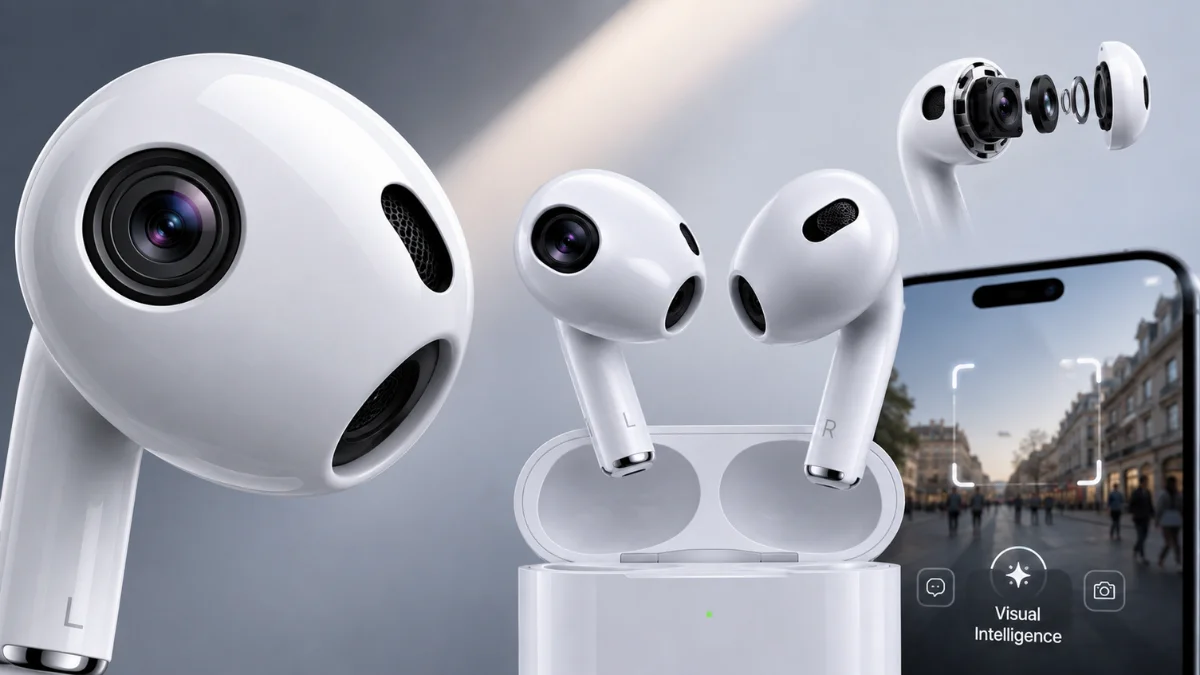
 Apple AirPods with cameras may sound like an unusual idea, but newly discovered code has revealed how Apple’s future earbuds could actually use tiny cameras. Rather than turning AirPods into miniature action cameras, Apple appears to be developing them as visual sensors that could help Siri and Visual Intelligence understand the world around you.
Code found inside macOS Tahoe 26.7 RC points to cameras in both earbuds, synchronised image capture, different active and background modes, person detection and even a hardware indicator that could alert people when the cameras are being used.
The findings give us a much clearer idea of what Apple may be planning. However, there is an important detail: the code could relate to an earlier prototype, so the final AirPods may work differently.
Here’s what we know so far.
Why Would Apple Put Cameras in AirPods?
The obvious question is: why do earbuds need cameras at all?
Based on the available evidence, Apple does not appear to be trying to replace your iPhone camera.
Instead, the cameras could give Siri and Visual Intelligence a view of your surroundings.
Imagine looking at a restaurant sign and asking Siri what it says, identifying an object without taking your phone out, or getting information about something directly in front of you.
For example, a recently discovered Apple demo showed camera-equipped AirPods being used with a book. This provided an early look at how Visual Intelligence could use information captured from the wearer’s surroundings.
Therefore, the cameras appear to be more about AI understanding than photography.
Apple AirPods With Cameras Could Use Two Sensors
The newly discovered code suggests that Apple has experimented with placing an individual colour camera on each AirPod.
The two cameras can capture synchronised RGB still images with matching frame information.
Using cameras on both sides could give Apple’s software two views of the same scene. That may help the system better understand objects, positioning and the environment around the wearer.
The framework also references calibration between cameras and motion sensors. In addition, it includes lens-distortion correction and ways to deal with head movement.
That makes sense because cameras attached to earbuds would constantly move whenever someone walks, talks or turns their head.
Camera Resolution May Be Surprisingly Low
Anyone expecting iPhone-quality photography will probably be disappointed — but that appears to be intentional.
The discovered software points towards two main capture modes.
| Camera Mode | Capture Resolution | Possible Output | Likely Purpose |
|---|---|---|---|
| Active | 640 × 640 | 1024 × 1024 | User-requested Visual Intelligence |
| Passive | 320 × 320 | 320 × 320 or 512 × 512 | Background environmental awareness |
In active mode, the system can capture a 640 × 640 frame before returning a processed image measuring up to 1024 × 1024 pixels.
Meanwhile, passive mode works at a much lower 320 × 320 capture resolution.
These figures describe the capture pipeline found in the software. They do not necessarily reveal the cameras’ full native sensor resolution.
Still, they strongly suggest that taking beautiful photos isn’t the goal.
Apple may simply need enough visual information for AI to identify an object, understand text or analyse part of the user’s surroundings.
These AirPods May Not Record Normal Video
This is another important distinction.
The framework supports one-shot and periodic still-image capture, but the discovered implementation does not point towards conventional video recording.
In other words, future AirPods might repeatedly provide visual frames to Apple’s intelligence system without behaving like a normal video camera.
For users, that difference matters.
Apple could potentially create an AI wearable that understands what is happening nearby without positioning it as a device for recording lengthy videos.
Nevertheless, periodic image capture will inevitably raise privacy questions.
Active and Passive Camera Modes Explained
The code suggests Apple has tested both active and passive ways of collecting visual information.
Active mode would likely make sense when a user intentionally asks Siri to analyse something.
For example:
“Siri, what am I looking at?”
The AirPods could capture the scene, allow Visual Intelligence to analyse it and then provide an answer.
Passive mode is more interesting.
Software references point towards contextual signals involving nearby speech, movement, head rotation, changes in surrounding audio and other conditions.
However, the code does not prove that every one of these events automatically triggers the cameras.
Therefore, it would be premature to describe future AirPods as continuously photographing everything around the wearer.

Person Detection Could Happen on the AirPods
Apple may also perform some processing directly on the earbuds.
References to peripheral inference suggest the hardware could detect whether a person appears within the camera’s view.
On-device processing could have several advantages.
First, it may reduce the amount of information that needs to travel to another device. Moreover, it could help the system respond faster to its surroundings.
Person detection also raises an obvious question: would AirPods stop capturing when another person appears?
The currently discovered code does not provide enough evidence to say that they would.
Consequently, Apple’s eventual privacy implementation will be extremely important.
Apple Appears to Be Testing a Camera Status Light
Perhaps the most important privacy-related discovery is a hardware indicator.
The framework includes controls for an indicator and even references adjusting its brightness.
That strongly suggests Apple has explored using a physical light to show when visual capture is happening.
We already see a similar concept on other camera-equipped wearables. A visible indicator can help people nearby understand when a wearable device is actively using its camera.
However, the code alone does not reveal exactly where the indicator would sit, how bright it would be or under which conditions Apple would activate it.
Those details could determine how comfortable people feel around camera-equipped AirPods.
Privacy Could Become Apple’s Biggest Challenge
Technically, camera-equipped AirPods are fascinating.
Socially, they could be complicated.
People are already accustomed to cameras on smartphones because it is usually obvious when someone points a phone at them. Cameras built into earbuds are far less noticeable.
Someone could simply appear to be listening to music while their earbuds contain visual sensors.
That creates several questions.
Will people nearby always know when image capture occurs? Will users be able to access the captured images? How long will visual information remain available? Will processing happen locally or in the cloud? What happens when another person enters the frame?
Apple has not publicly answered those questions because it has not officially announced this product.
Still, the apparent hardware indicator suggests privacy is at least part of the engineering discussion.
Could Camera AirPods Help With Accessibility?
There is another side to this technology that should not be overlooked.
Visual Intelligence inside wearable earbuds could potentially become a powerful accessibility tool.
For someone with limited vision, AI-enabled AirPods could theoretically help identify objects, read signs, recognise surroundings or provide contextual information without requiring the user to hold up an iPhone.
For example, a user might ask Siri to identify an object in front of them or read visible information aloud.
Apple has a long history of building accessibility features into mainstream products. Therefore, visual sensors in AirPods could eventually have applications far beyond convenience.
However, we will need to see Apple’s final implementation before knowing exactly which accessibility capabilities are supported.
Could Siri Become More Useful With Visual Intelligence?
Camera-equipped AirPods could also represent a bigger change for Siri.
Voice assistants traditionally understand what you say. Giving Siri access to visual context could allow it to understand what you see as well.
That opens the door to much more natural questions.
Instead of taking a photo and manually searching for information, a user could potentially look towards something and simply ask about it.
The combination of cameras, microphones, motion sensors and AI could therefore turn AirPods into something closer to a wearable assistant.
This may ultimately be more important than the camera hardware itself.
Apple’s push towards smarter wearables is only one part of its wider AI strategy. You can also explore our latest coverage of iOS 27 features to see what Apple is changing across the iPhone experience. Meanwhile, our latest iPhone 18 leaks coverage looks at the hardware Apple may introduce alongside its next generation of AI-focused software and devices.
Are These the AirPods Apple Will Actually Release?
Not necessarily.
This is one of the most important details surrounding the leak.
The AirPods shown in an earlier discovered demo reportedly resemble a camera-equipped version of the AirPods Pro 3 associated with the codename B790.
However, reporting from Bloomberg’s Mark Gurman has indicated that Apple moved away from that particular model and has been developing another camera-equipped generation under the B798 codename.
Therefore, the software findings are best viewed as evidence of how Apple has been developing the technology, rather than a confirmed specification sheet for a retail product.
Apple could change the cameras, sensors, design, privacy system or other features before launch.
When Could Apple AirPods With Cameras Launch?
Apple has not announced an official release date.
Current reporting has pointed towards 2027 for Apple’s camera-equipped AirPods project.
That means buyers should not assume these earbuds will necessarily arrive with Apple’s next immediate hardware launch.
Development schedules can also change, particularly for an entirely new type of wearable device.
For now, the important development is that Apple’s software provides considerably more evidence that camera-equipped AirPods are more than a simple concept.
AirPods With Cameras: What the Leak Tells Us
Here is the situation in simple terms:
- Apple has been developing AirPods equipped with visual sensors.
- Code suggests there could be a colour camera in each earbud.
- The cameras can provide synchronised still images.
- Active capture can produce processed images up to 1024 × 1024.
- Lower-resolution passive capture is also referenced.
- Conventional video recording has not been found in the current implementation.
- Person detection could happen directly on the earbuds.
- Apple has tested controls for a hardware capture indicator.
- Visual Intelligence appears to be a major reason for adding cameras.
- The final retail hardware could differ from the prototype reflected in the code.
Are Camera-Equipped AirPods Actually a Good Idea?
That will depend heavily on execution.
If Apple simply adds cameras without providing a meaningful benefit, many users may question why they need them.
However, if Visual Intelligence lets AirPods understand surroundings, answer useful questions and improve accessibility while keeping sensitive processing private, the feature could change how people interact with Siri.
The privacy safeguards will be just as important as the AI features.
Apple needs to make it obvious when cameras are active and clearly explain what happens to captured information. Without that transparency, users — and people standing around them — may understandably feel uncomfortable.
Final Thoughts
Apple AirPods with cameras are starting to look much more realistic after new macOS code revealed details about image capture, person detection, active and passive modes, and a possible hardware status light.
Most importantly, these cameras do not appear designed primarily for traditional photography. Instead, Apple seems interested in giving Visual Intelligence and Siri enough visual context to understand what is happening around the wearer.
That could make future AirPods far more capable than today’s wireless earbuds.
However, the same technology creates serious privacy questions, particularly when cameras become small enough to disappear into everyday devices.
Apple has not officially announced camera-equipped AirPods, and the discovered code may relate partly to an earlier prototype. Therefore, the final product could still look and behave differently.
If Apple eventually launches the technology in 2027, its success may depend on something beyond camera resolution or AI performance: whether users trust it.
Frequently Asked Questions
Are Apple making AirPods with cameras?
Evidence found in Apple’s software and previous reporting indicates that Apple has been developing camera-equipped AirPods. However, Apple has not officially announced a retail model.
What would cameras on AirPods be used for?
The cameras appear primarily intended to provide visual information to features such as Siri and Visual Intelligence rather than replace an iPhone camera.
Can Apple’s camera AirPods record video?
The implementation discovered in macOS supports still-image capture and periodic frames. Researchers did not find conventional video-recording functionality in the framework.
What resolution could AirPods cameras use?
The discovered active mode captures at 640 × 640 and can return a processed 1024 × 1024 image. Passive capture operates at lower resolutions. These figures do not necessarily represent the physical sensor’s maximum resolution.
Will people know when AirPods cameras are active?
The code includes controls for a hardware indicator and its brightness, suggesting Apple has experimented with a visible capture light. Apple has not confirmed how this would work on a final product.
When will Apple release AirPods with cameras?
Apple has not announced a launch date. Current reporting suggests a new generation of camera-equipped AirPods could arrive in 2027, although Apple’s plans may change.


