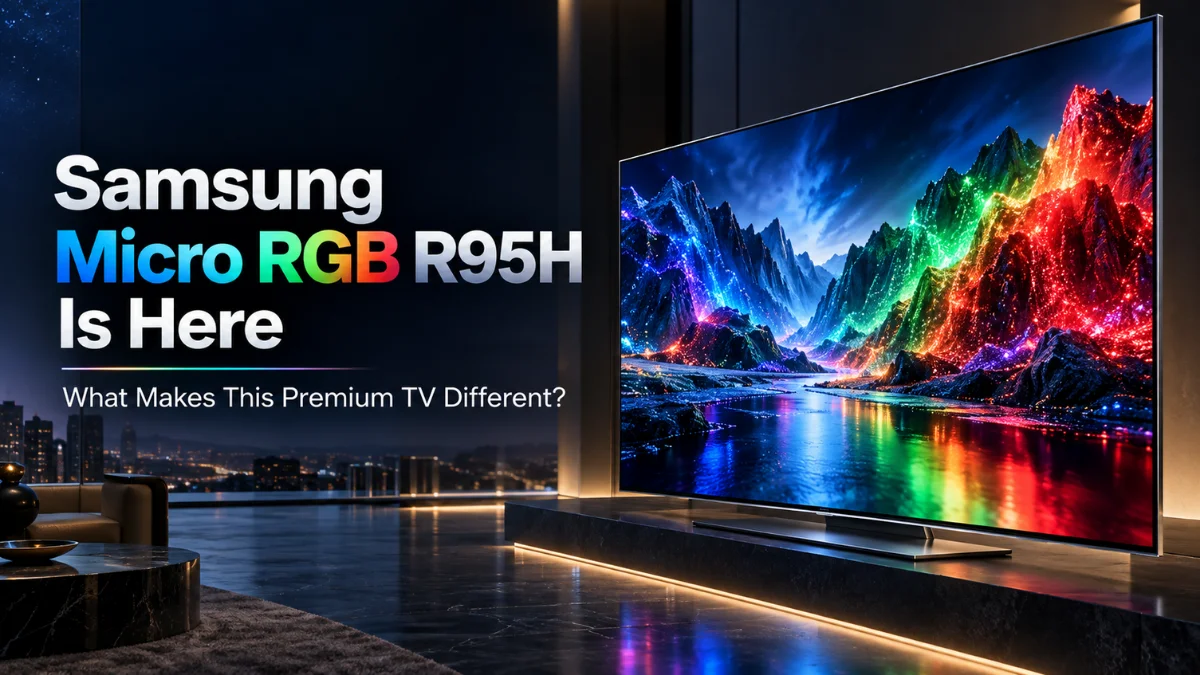
Samsung Micro RGB R95H Is Here: What Makes This Premium TV Different?
 By Inflix
 Samsung already sells premium OLED, Neo QLED and MicroLED displays. Now, the Samsung Micro RGB R95H adds another option by changing something fundamental behind the LCD panel: the colour of the backlight itself.
Samsung launched its full 2026 TV range in the UK on 15 May 2026, with Micro RGB sitting at the premium end of the lineup. The R95H is the higher-tier Micro RGB series, using microscopic red, green and blue LEDs to create the backlight instead of the predominantly white or blue-light approach associated with conventional LED and Mini LED TVs.
That distinction is the main reason this TV matters. Samsung says the technology enables more precise control over both colour and brightness, while the Micro RGB AI Engine Pro handles colour, motion, depth and 4K upscaling. The R95H also combines that new display system with up to 165Hz VRR, Dolby Atmos, Samsung Gaming Hub, Tizen and a broad selection of AI features.
For readers following Mobile Verse Gadgets & Reviews, here is what Micro RGB actually means, how it differs from OLED and MicroLED, and what buyers get for the R95H’s premium price.
Samsung Micro RGB R95H: Quick Overview
| Specification | Samsung Micro RGB R95H |
|---|---|
| Display technology | Micro RGB LED backlight with LCD panel |
| UK sizes | 65, 75, 85 and 115 inches |
| Resolution | 3,840 × 2,160 4K |
| Native refresh rate | 100Hz |
| VRR | Up to 165Hz |
| Processor | Micro RGB AI Engine Pro on 65/75/85-inch models |
| HDR | Micro RGB HDR Pro, HDR10+ |
| Colour | Micro RGB Precision Colour 100 |
| Colour gamut claim | 100% BT.2020 coverage, VDE certified |
| Anti-reflection | Glare Free |
| Gaming | 4K/165Hz PC support, VRR, ALLM, FreeSync Premium Pro, Gaming Hub |
| Smart platform | Tizen |
| Audio | Dolby Atmos, OTS+, Q-Symphony; 4.2.2ch/70W on 85-inch |
| Connectivity | Four HDMI ports, Wi-Fi 6E, Bluetooth 5.3 on 85-inch |
| UK launch | 15 May 2026 full-lineup launch |
| UK price | Varies by size and retailer |
Samsung’s UK documentation lists the R95H in 65, 75, 85 and 115-inch sizes. However, there is a specification distinction within that range: Samsung’s Micro RGB overview lists the 115-inch version with the Micro RGB AI Engine, Micro RGB HDR+ and 144Hz Motion Xcelerator, while the smaller 65, 75 and 85-inch R95H models use the more advanced Micro RGB AI Engine Pro, Micro RGB HDR Pro and Motion Xcelerator 165Hz.
That is worth remembering when comparing R95H specifications because the 115-inch version should not automatically be assumed to match every specification of the smaller 2026 models.
What Is the Samsung Micro RGB R95H?
The Samsung Micro RGB R95H is the premium model in Samsung’s expanded 2026 Micro RGB TV family. It sits above the R85H, which covers more screen sizes but uses a slightly less advanced specification in areas such as refresh rate, HDR processing and audio.
Samsung first announced its expanded 2026 Micro RGB range in December 2025 before showing the technology at CES 2026. The company subsequently launched its full 2026 TV lineup in the UK on 15 May.
The R95H is not Samsung’s first Micro RGB product. The company had already tested the category with an enormous 115-inch model in 2025. What makes the 2026 generation more relevant to ordinary premium-TV buyers is the arrival of smaller sizes, including 65, 75 and 85 inches.
Samsung also unveiled a 130-inch R95H at CES 2026, but Samsung’s current UK model comparison lists the retail R95H range at 65, 75, 85 and 115 inches. The 130-inch announcement should therefore not be treated as confirmation that this size is currently part of the standard UK retail range.
What Is Micro RGB and How Does It Work?
This is where the R95H becomes genuinely interesting.
A conventional LCD TV needs a backlight because the LCD layer cannot create its own light. Many LED TVs use white or blue LEDs behind that panel, while Mini LED TVs make those backlight elements much smaller so the television can control light more precisely across different parts of the picture.
Samsung Micro RGB changes the backlight itself. Instead of relying on a conventional single-colour LED backlight and then creating the final colours through the display system, Samsung uses microscopic red, green and blue LEDs. Samsung says each Micro RGB LED measures under 100 micrometres.
Those RGB LEDs can be controlled to refine both colour and brightness in different areas of the image. In simple terms, the TV has more direct control over the colour of the light it sends through the LCD layer. This is also why Micro RGB should not be confused with MicroLED.
On a true MicroLED display, microscopic red, green and blue LEDs form the actual self-emissive picture pixels. They produce their own light, so the display does not require a separate LCD layer or traditional backlight. Samsung Micro RGB remains a backlit display. The microscopic RGB LEDs illuminate an LCD panel rather than becoming the final image pixels themselves.
That distinction matters because the names sound remarkably similar while describing fundamentally different display architectures. For readers interested in how manufacturers are changing display hardware, Samsung technology is becoming increasingly diverse as OLED, Neo QLED, MicroLED and Micro RGB now occupy different parts of the company’s premium TV range.
What Makes Samsung Micro RGB Different?
The biggest difference is colour control.
A traditional LCD television needs to manipulate light from its backlight to reproduce red, green and blue colours on screen. Micro RGB starts with independently produced red, green and blue light at the backlight level, giving Samsung another layer of control over the colour reaching the LCD panel. Samsung says its Micro RGB Precision Colour system achieves 100% coverage of the BT.2020 wide colour gamut. The company says this performance has been certified by VDE against criteria aligned with the BT.2020 UHD colour standard.
BT.2020 defines a much wider range of colours than older television standards. Covering more of it gives a TV the potential to reproduce highly saturated colours that narrower-gamut displays cannot show accurately.
However, 100% BT.2020 coverage does not automatically mean every film or TV programme will suddenly look dramatically different. Content needs to contain the relevant colour information, and picture accuracy depends on processing, calibration, brightness and other aspects of the display. The R95H also uses local dimming to control brightness across the Micro RGB backlight. This allows the television to reduce light in dark areas while keeping brighter sections illuminated, helping improve perceived contrast. Samsung combines this hardware with Micro RGB Colour Booster Pro and Micro RGB HDR Pro, which use processing to optimise colour and contrast scene by scene.
Glare Free technology is another advantage of the R95H over the R85H. Samsung designed the screen treatment to reduce distracting reflections from windows and indoor lights, which could make the television particularly relevant for bright living rooms.
Samsung Micro RGB vs Mini LED vs OLED vs MicroLED
The easiest way to understand Micro RGB is to compare how each major premium display technology creates light.
| Feature | Micro RGB | Mini LED LCD | OLED | MicroLED |
|---|---|---|---|---|
| How it works | Microscopic RGB LED backlight behind LCD | Tiny LED backlight behind LCD | Self-emissive organic pixels | Self-emissive microscopic inorganic LEDs |
| Separate backlight | Yes | Yes | No | No |
| Pixel-level black control | No | No | Yes | Yes |
| Local dimming | Yes | Yes | Not required | Not required |
| Colour approach | RGB backlight + LCD | Typically conventional backlight + LCD colour system | Individual self-emissive pixels | Individual RGB LED pixels |
| Burn-in consideration | No organic OLED pixel layer | No organic OLED pixel layer | Permanent image retention is a consideration | No organic OLED pixel layer |
| Market position | Premium/new | Mainstream to premium | Mid-range to premium | Ultra-premium |
| Availability | Expanding in 2026 | Widely available | Widely available | Limited/very expensive |
Micro RGB and Mini LED are conceptually related because both remain LCD-based televisions with backlights. Micro RGB’s distinguishing feature is that Samsung shrinks separate red, green and blue LEDs to microscopic scale and uses them for highly precise colour and brightness control.
OLED takes another approach. Each OLED pixel produces its own light and can turn completely off, which gives the technology exceptionally precise black levels without relying on local dimming zones. Micro RGB still needs to manage light behind an LCD panel, so blooming around bright objects can remain possible depending on the television’s dimming performance. MicroLED combines some of the conceptual advantages of self-emissive displays with inorganic LED technology, but manufacturing very large numbers of microscopic RGB pixels remains complex and expensive. That is one reason consumer MicroLED televisions remain far less accessible.

Micro RGB therefore occupies an interesting middle ground. It tries to push conventional backlit LCD technology further rather than replacing the LCD layer entirely. No technology is automatically superior in every situation. Real-world performance depends on the individual television, its processing, brightness, dimming system, viewing environment and content.
Picture Quality and AI Features
The 65, 75 and 85-inch R95H models use Samsung’s Micro RGB AI Engine Pro.
Samsung says the processor analyses colour, motion and depth while controlling the RGB backlight. The company also compares its processing hardware with the NQ4 AI Processor used in 2026 Neo QLED 4K TVs, claiming a 67% faster CPU, twice the NPU performance and 4.2 times the GPU performance. These are Samsung’s internal comparison figures rather than independent benchmark results. 4K AI Upscaling Pro attempts to improve lower-resolution material for the 4K panel. AI Motion Enhancer Pro targets moving objects and text, while Auto HDR Remastering Pro analyses SDR content and adjusts it to produce a more HDR-like presentation.
Micro RGB Colour Booster Pro has a more technology-specific job. Samsung says it identifies muted colour areas and adjusts them to take advantage of the wider RGB backlight. The R95H also supports Samsung Vision AI Companion. The platform combines Samsung’s TV interface with AI-powered search, recommendations and conversational features. Samsung’s UK documentation lists Live Translate, Generative Wallpaper, AI Football Mode Pro and AI Sound Controller Pro among the R95H’s Vision AI features.
For readers following AI-powered devices, this is a good example of how television manufacturers are increasingly applying AI to both picture processing and the smart-TV interface rather than limiting it to voice assistants.
Is the Samsung R95H Good for Gaming?
The R95H has a strong gaming specification, particularly on its 65, 75 and 85-inch versions.
Samsung lists a native refresh rate of 100Hz with VRR up to 165Hz. All four HDMI inputs on the 85-inch model support high-frame-rate signals, with Samsung specifying up to 4K at 165Hz when connected to a compatible PC. Console VRR at 4K/120Hz is also supported.
The main confirmed gaming features include:
- VRR and Auto Low Latency Mode
- AMD FreeSync Premium Pro
- AI Gaming Optimiser
- Samsung Gaming Hub
- Game Bar
- Super Ultra Wide Game View
- HGiG
- 4K/165Hz support with compatible PCs
Samsung Gaming Hub brings supported cloud services including Xbox, Amazon Luna and GeForce NOW into one interface, although availability, subscriptions and controller requirements vary by service and region. For a PS5 or Xbox Series X, the important features are 4K/120Hz, VRR and ALLM rather than the headline 165Hz figure. PC gamers with compatible hardware can make greater use of the higher refresh-rate ceiling.
Samsung confirms FreeSync Premium Pro but does not list NVIDIA G-SYNC certification for the R95H in its UK specifications. It is therefore better not to claim official G-SYNC compatibility without additional model-specific confirmation.
Sound and Smart TV Features
The 85-inch R95H uses a 4.2.2-channel speaker system rated at 70W, with eight built-in speakers. Samsung supports Dolby Atmos alongside Object Tracking Sound+, which attempts to position sound according to movement within the picture.
Q-Symphony lets compatible Samsung soundbars and the television’s speakers operate together rather than disabling the TV speakers when a soundbar is connected. Active Voice Amplifier Pro and Adaptive Sound Pro also adjust audio according to content and listening conditions. The smart platform is Samsung’s Tizen OS. The R95H includes Samsung TV Plus, SmartThings support, a built-in SmartThings/Matter hub and far-field voice interaction. Alexa is built in for the UK market, while Samsung also lists compatibility with Google Assistant-equipped speakers.
Samsung says Tizen OS upgrades for its 2026 televisions will be supported for up to seven years, although that commitment concerns software rather than guaranteeing future hardware features. The R95H’s security update period is listed through at least 31 December 2031. Connectivity on the 85-inch model includes Wi-Fi 6E, Bluetooth 5.3, four HDMI inputs, eARC, two USB-A ports, Ethernet and optical audio output. It is also Wireless One Connect Ready. Samsung includes its SolarCell Remote, which recharges using indoor lighting or sunlight instead of relying on disposable batteries.
Samsung Micro RGB R95H Design
The 65, 75 and 85-inch R95H models use Samsung’s Infinity Air design.
The concept keeps the visible bezels extremely narrow so the display appears to occupy almost the entire front surface. Samsung describes it as a four-bezel-less design, while the stand uses a Space Graphite finish. The design also helps distinguish the premium R95H from the lower R85H, which uses Samsung’s Monolith Edge design.
At these screen sizes, installation deserves consideration alongside aesthetics. The 85-inch model weighs 37.9kg without its stand and 40kg with it, so wall mounting requires suitable hardware and careful installation. For more coverage of premium televisions, smartphones and other consumer technology, Mobile Verse’s gadget section provides a natural place to continue exploring new hardware.
Samsung Micro RGB R95H Price and Available Sizes
Samsung’s UK support documentation confirms four R95H sizes: 65, 75, 85 and 115 inches. The related R85H expands Micro RGB further down the range with 55, 65, 75, 85 and 100-inch options.
Pricing has changed since launch and can vary by retailer and promotion. Samsung Newsroom’s recent R95H review feature cites original UK pricing of £3,399 for the 65-inch model and £4,299 for the 75-inch model. Current retail pricing can be lower. At the time of checking, Currys listed the 65-inch R95H at £2,899, reduced from £3,099 during an earlier pricing period.
That is why buyers should distinguish launch price, Samsung’s current direct price and temporary retailer discounts rather than treating one figure as permanent. The 115-inch model sits in a very different size and pricing category. Buyers should also remember that its processing, HDR and refresh-rate specifications differ from the smaller R95H models.
Is Samsung Micro RGB R95H Available in the UK?
Yes. Unlike many premium TVs that reach Britain months after their initial announcement, the R95H is already an official part of Samsung’s UK lineup.
Samsung announced the UK launch of its full 2026 television range on 15 May 2026. The company’s UK website currently has dedicated R95H product pages for multiple sizes, while UK retailers also list the television. The 65, 75, 85 and 115-inch R95H sizes are listed in Samsung’s official UK comparison documentation. Buyers looking for smaller Micro RGB options can instead consider the R85H series, which goes down to 55 inches.
Samsung has therefore moved Micro RGB beyond the demonstration stage. The bigger question is whether prices will continue to fall as production expands and the technology reaches more screen sizes. Readers tracking new televisions and home entertainment hardware can follow latest gadget news as the Micro RGB category develops.
Who Is Samsung’s Micro RGB TV Aimed At?
The R95H sits firmly in the premium television market.
Its strongest technical differentiator is the RGB backlight and resulting colour gamut rather than simply resolution. 4K televisions are common, but Samsung is targeting viewers who care about HDR colour, bright-room performance, large screen sizes, premium gaming features and advanced picture processing.
The Glare Free screen may be particularly relevant in bright rooms where reflections can undermine the benefits of a premium panel. Meanwhile, the four high-bandwidth HDMI connections, VRR and 165Hz PC capability make the smaller R95H models relevant to high-end gaming setups. OLED remains attractive for buyers prioritising pixel-level black control and self-emissive contrast. Mini LED TVs may offer similar LCD-based strengths at lower prices, while true MicroLED remains an ultra-premium proposition.
Micro RGB does not make those technologies obsolete. Instead, Samsung is creating another premium display category that tries to combine the brightness advantages associated with high-end LCD TVs with much finer colour control.
Final Thoughts
What makes the Samsung Micro RGB R95H different is not simply another AI feature or a higher refresh-rate number. The fundamental change happens behind the LCD panel, where microscopic red, green and blue LEDs give Samsung much finer control over the colour and brightness of the backlight.
That approach has already produced measurable technical achievements, including VDE-certified 100% BT.2020 colour-gamut coverage. The R95H then adds Samsung’s Micro RGB AI Engine Pro, Glare Free treatment, advanced gaming support and the company’s expanding Vision AI platform. However, Micro RGB is not MicroLED, nor does it automatically make OLED or Mini LED outdated. It remains an LCD-based technology, and the R95H’s premium pricing means individual picture performance and viewing conditions still matter when comparing alternatives.

The bigger story is that Samsung has moved Micro RGB from an enormous showcase television into more conventional 65, 75 and 85-inch sizes. That makes the technology far more relevant to the premium TV market than it was a year ago. For more coverage of emerging displays and smart TV technology, Mobile Verse will continue tracking how Micro RGB develops as Samsung expands the range.
Frequently Asked Questions
What is Samsung Micro RGB?
Samsung Micro RGB is an LCD TV technology that uses microscopic red, green and blue LEDs measuring under 100 micrometres as the backlight. Samsung uses local control of those RGB LEDs to improve colour and brightness precision.
Is Samsung Micro RGB the same as MicroLED?
No. Samsung Micro RGB uses microscopic RGB LEDs as a backlight behind an LCD panel. MicroLED uses microscopic self-emissive LEDs as the actual picture pixels and therefore does not require a separate LCD layer or backlight.
What is the Samsung Micro RGB R95H price?
Pricing depends on size and current promotions. Samsung Newsroom recently cited UK pricing of £3,399 for the 65-inch and £4,299 for the 75-inch R95H, while current retailer discounts can reduce those figures.
What sizes does the Samsung Micro RGB R95H come in?
Samsung UK lists the 2026 R95H in 65, 75, 85 and 115-inch sizes. Samsung also offers the R85H Micro RGB series from 55 to 100 inches.
Is Samsung Micro RGB better than OLED?
There is no universal answer. Micro RGB uses an RGB backlight and can target high brightness, wide colour coverage and strong bright-room performance. OLED is self-emissive and provides pixel-level black control. Actual performance depends on the specific models and viewing environment.
Is the Samsung R95H good for gaming?
Its confirmed gaming specification is extensive. The 65, 75 and 85-inch models support VRR up to 165Hz, 4K/120Hz console gaming, FreeSync Premium Pro, ALLM, Game Bar and Samsung Gaming Hub. The 165Hz mode requires compatible PC content.
Is the Samsung Micro RGB R95H available in the UK?
Yes. Samsung launched its full 2026 TV range in the UK on 15 May 2026, and the R95H has official UK product pages in multiple sizes.
Does Samsung Micro RGB suffer from OLED burn-in?
Micro RGB does not use the organic self-emissive pixel structure found in OLED panels, so OLED-style organic-pixel burn-in is not the same design consideration. However, that should not be interpreted as a guarantee against every possible form of image retention or display ageing.