
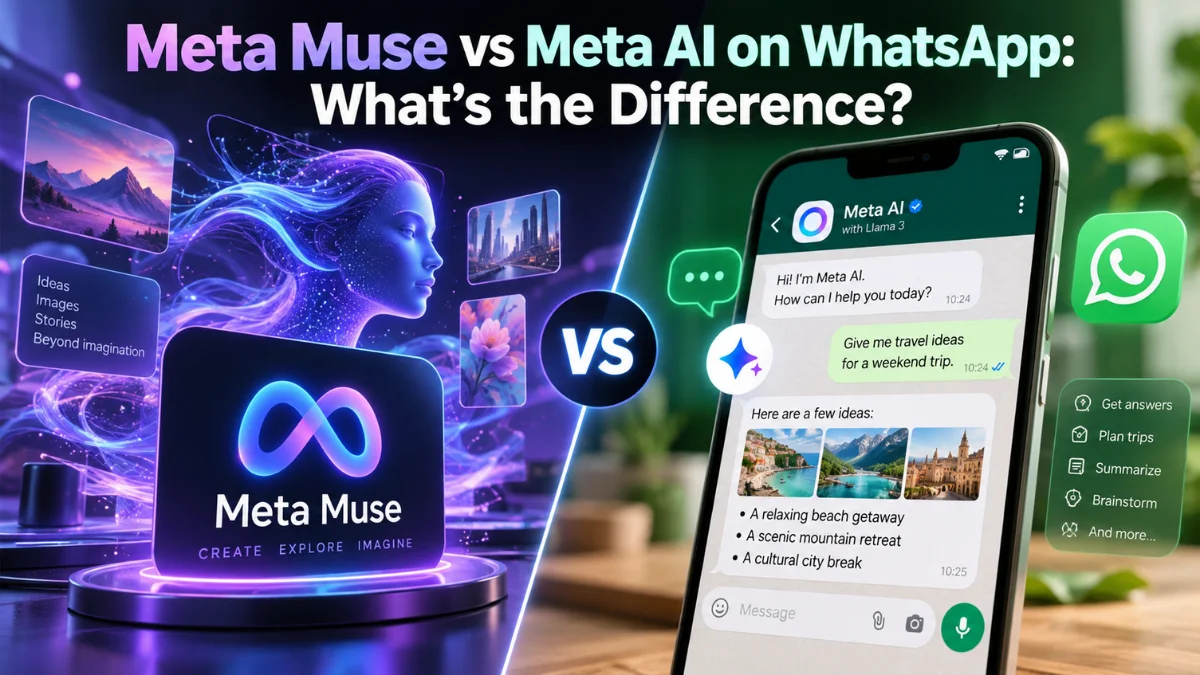
Meta Muse vs Meta AI on WhatsApp: What’s the Difference?
 By Inflix
 Meta has introduced a new AI agent called Muse, and WhatsApp users now have another name to understand alongside Meta AI. Both use artificial intelligence, but they are designed for different types of help.
The main difference in Meta Muse vs Meta AI is what happens after you make a request. Meta AI mainly helps users ask questions, generate content and find information, although newer versions can also perform selected tasks. Muse goes further by acting as a personal agent that can use connected services, carry out longer projects and continue working in the background.
Meta officially launched Muse on 8 September 2026 and confirmed that people can communicate with it directly through WhatsApp. However, Muse’s initial rollout focuses on the United States, so users in the UK, Pakistan and other countries should not assume they already have access.
Meta Muse vs Meta AI: What’s the Main Difference?
Meta AI is the assistant that many WhatsApp users already recognise. It can answer questions, help draft messages, suggest ideas and provide other AI-powered features, depending on the user’s country and available updates.
Muse is a separate personal AI agent. Instead of stopping after providing an answer, it can take steps towards completing a task, such as organising a project, filling out forms or helping arrange travel. It uses a dedicated cloud-based computer and can connect to approved services.
The distinction is not absolute because Meta has also added task-performing features to Meta AI. In July 2026, the company introduced more advanced planning, research and connected-app capabilities through Muse Spark 1.1. Nevertheless, Muse places ongoing action, personal context and background work at the centre of its experience.
For everyday WhatsApp users, the simplest explanation is that Meta AI is useful for getting help during a conversation, while Muse is designed to take responsibility for more of the work that follows.
What Is Meta Muse?
Meta Muse is a personal AI agent designed to help people manage tasks and achieve goals. Meta introduced it in September 2026 as a separate experience available through the Muse app, its website and WhatsApp, subject to rollout restrictions.
Muse runs on a system called Muse Secure VM. A virtual machine is a separate computing environment, and Meta gives each Muse agent a dedicated cloud-based workspace with its own browser. This allows the agent to interact with websites and connected services while working on a user’s behalf. For example, a person could ask Muse to help plan a trip. Rather than only suggesting destinations, the agent can research options, develop a plan and perform supported actions through connected services. Meta also describes email tasks, online forms, shopping and longer projects among its capabilities.
Muse can continue working after someone closes the app. It can return with progress updates, request approval for sensitive actions and use information the user has chosen to share. This ongoing approach is one of the biggest differences between Muse and a conventional chatbot.
What Is Muse Spark, and How Is It Different From Muse?
Muse Spark is an AI model, not another standalone WhatsApp assistant. Meta introduced it in April 2026 as the first model in a new series developed by Meta Superintelligence Labs.
The model helps power Meta AI’s reasoning, image understanding and conversational capabilities. Meta later introduced Muse Spark 1.1, which supports more advanced planning and connected-app functions. Muse, the personal agent, also relies on Muse technology to understand instructions and carry out work.
Think of Muse Spark as part of the intelligence behind the products. Meta AI is an assistant that uses this technology, while Muse combines AI models with tools, memory, permissions and a computing environment that can perform actions. This distinction matters because an update to Muse Spark does not automatically mean every WhatsApp user receives the same new feature. Meta controls the availability of each consumer experience separately.
What Is Meta AI on WhatsApp?
Meta AI is Meta’s conversational assistant, integrated into supported versions of WhatsApp. Users can ask questions, request explanations, generate ideas and get help with everyday writing tasks without switching to another AI application.
For example, someone planning a family dinner could ask Meta AI for meal ideas, a shopping list or a message inviting guests. The assistant can produce suggestions within the conversation, making it useful for quick tasks that do not require extensive setup.
Meta has also expanded its capabilities beyond simple text responses. Muse Spark brought stronger reasoning and multimodal features, while Muse Image introduced image-generation capabilities in supported markets. Availability still depends on the particular feature and rollout. In July, Meta announced that its assistant could connect to email and calendar services, conduct research, create slides and handle recurring tasks in selected markets. These additions mean Meta AI is no longer limited to answering questions, even though its everyday WhatsApp experience remains distinct from Muse.
Meta Muse vs Meta AI: Features Compared
The differences become clearer when looking at what each product is designed to do. Both belong to Meta’s AI ecosystem, but their interfaces, tools and availability are not identical.
| Feature | Meta Muse | Meta AI |
|---|---|---|
| Product type | Personal AI agent | AI assistant |
| Main purpose | Complete tasks and pursue goals | Answer questions and provide assistance |
| WhatsApp access | Meta confirms direct WhatsApp interaction | Integrated into supported WhatsApp versions |
| Background work | Core feature | Selected task features |
| Website interaction | Dedicated browser through Muse Secure VM | Depends on supported tools |
| Email and connected apps | User-approved connections | Available in selected experiences |
| Personal memory | Designed to retain useful context | Personalisation varies by product |
| Image generation | Not its defining feature | Supported through Meta AI features |
| Privacy controls | Secure VM, permissions and action approvals | WhatsApp AI controls and supported private modes |
| Availability | Initial US rollout | Wider, feature-dependent availability |
| Pricing | Free basic use; paid plans for more | Core access generally free where supported |
The table does not mean Meta AI lacks every advanced function that Muse offers. Meta has been adding agent-like capabilities to Meta AI throughout 2026, and the two experiences may continue to overlap. The more useful difference is how they approach a request. Meta AI often starts with a conversation, while Muse is built around managing a goal and taking approved actions to achieve it.
Can You Use Meta Muse on WhatsApp?
Yes. Meta’s official September announcement specifically confirms that people can communicate with Muse directly in WhatsApp, much like messaging another person. This is different from using the familiar Meta AI assistant within the messaging app.
However, Meta initially launched Muse in the United States across iOS, Android and its website. The company has not established that every WhatsApp user worldwide can access the same Muse experience. Users should therefore avoid assuming that Muse has appeared automatically in their existing Meta AI chat. The two products have separate identities, and access may depend on account eligibility and regional rollout. Meta has also announced plans to bring Muse to its AI glasses. This would extend the personal agent beyond phones and computers, allowing supported glasses to interact with the agent hands-free.
What Can Meta Muse Do That Meta AI Cannot?
Muse’s strongest advantage is its dedicated environment for carrying out work. It can use its own browser, interact with approved websites and continue working while the user is away.
Imagine asking for help organising a holiday. Meta AI can explain destinations, compare options and produce a travel plan. Muse can take the process further by interacting with supported services and helping complete booking-related steps, while requesting approval where necessary.
The same principle applies to shopping, email and longer personal projects. Muse can remember relevant preferences, return to unfinished tasks and provide progress updates rather than requiring the user to restart the conversation. However, it would be misleading to say Meta AI cannot perform tasks at all. Meta’s July update already introduced connected apps, scheduled activities and more advanced research features in selected markets. The distinction is therefore about the overall agent experience, not a claim that one product has intelligence and the other does not.
Can Muse Send Emails, Make Purchases and Book Travel?
Meta officially lists sending emails, arranging travel and completing online tasks among Muse’s intended capabilities. The agent can use connected services and its browser to work towards those requests.
Muse does not receive unlimited permission to act. Meta says it asks users to approve sensitive actions, including sending emails and making purchases. People can also decide which services to connect and what level of access each connection receives. For payments, Meta has announced support involving Stripe’s Link checkout system, with additional payment integrations planned. These features do not mean every merchant or booking website will necessarily work with Muse.

Users should still review important details before approving transactions. An AI agent can misunderstand instructions or encounter a website it cannot complete successfully, so human oversight remains important.
Is Meta Muse Replacing Meta AI?
Meta has not announced that Muse will replace Meta AI on WhatsApp. Both products remain part of its wider AI strategy, with different approaches to helping users.
Meta AI continues to provide conversational assistance across WhatsApp, Instagram, Facebook, Messenger and other supported experiences. Muse adds a more dedicated personal-agent product that can pursue goals and perform work through connected tools. The underlying Muse Spark models help explain why the names sound similar. Meta can use related AI technology across several products without turning them into one application.
For readers following AI agents and WhatsApp updates, the important development is Meta’s shift towards software that can act rather than simply respond. Mobile Verse’s Artificial Intelligence coverage follows this wider move towards more capable personal assistants.
Meta Muse vs Meta AI: Privacy and Data Access
Privacy deserves particular attention because an AI agent can need more information than a chatbot answering general questions. Muse may require access to connected email accounts, websites or other services before it can complete certain tasks.
Meta says Muse operates inside a dedicated Muse Secure VM and uses a separate security agent called Sentinel to review external actions. Users control service connections, can withdraw access and receive an audit trail showing what Muse has done or plans to do. The company also says Muse cannot directly view passwords or payment details stored through its protected credential system. It requests approval before sensitive actions and does not share Muse conversations or virtual-machine data with Meta’s advertising systems, according to Meta’s published policy.
These are Meta’s stated safeguards, not a guarantee that any autonomous agent is free from security risks. People should grant only the permissions they need and review important actions before approving them.
Can Meta Muse Read Your Private WhatsApp Messages?
Using Muse through WhatsApp does not mean the agent automatically gains access to every private conversation. Access to a specific AI conversation should not be confused with unrestricted access to the user’s other chats.
Ordinary personal WhatsApp conversations retain their end-to-end encryption protections. However, messages deliberately shared with an AI service may be handled under the privacy arrangements for that particular AI feature. Meta also introduced Incognito Chat for Meta AI in May 2026. The company says this mode uses private processing to protect sensitive AI interactions and make them disappear by default. Users should not assume that Muse and Meta AI Incognito Chat use identical systems simply because both belong to Meta.
How to Use Meta AI on WhatsApp
If Meta AI is available in your country and account, open WhatsApp and look for the Meta AI entry point. Depending on the app version, this may appear as a dedicated AI chat or another supported interface.
Open the assistant and type a question or request. You could ask it to explain a topic, improve a message, suggest travel ideas or help organise information. Supported accounts may also have access to additional features such as image generation.
If Meta AI does not appear, update WhatsApp and check official availability information. A missing feature may reflect regional restrictions or a staged rollout rather than a problem with your phone. Muse has a separate rollout, so these steps should not be treated as instructions for activating Muse. Eligible users should follow Meta’s official Muse access process rather than looking for an unconfirmed setting inside Meta AI.
Is Meta Muse Available in the UK or Pakistan?
Meta’s September launch announcement identifies the United States as Muse’s initial rollout market. It does not establish general availability across the UK or Pakistan.
Meta AI has a wider presence through WhatsApp and other Meta services, although individual features still vary between countries. Users in either market may therefore have Meta AI without access to the new Muse agent.
There is no reason to assume that a VPN, changing a phone’s region or installing an unofficial application will provide supported Muse access. Waiting for an official regional launch is the more reliable approach. Mobile Verse will continue tracking Muse’s availability as Meta expands its personal AI products and connected-app features.
Which One Should WhatsApp Users Choose?
For ordinary questions, quick writing help and everyday ideas, Meta AI remains the more straightforward option. It is already integrated into supported WhatsApp experiences and does not require users to set up a dedicated agent for every small request.
Muse makes more sense for people who want an assistant to manage longer tasks. Its ability to work in the background, use approved connections and return with progress updates makes it particularly relevant to people handling several projects. However, convenience comes with additional decisions about privacy and permissions. Users who do not need an AI agent to access connected services may prefer the simpler Meta AI experience.

The right choice therefore depends on the task, the features available in your country and how much access you are comfortable granting. Neither product should be considered universally better for every WhatsApp user.
Final Verdict
The Meta Muse vs Meta AI comparison is not simply about which chatbot gives better answers. Meta AI is the familiar conversational assistant with growing task capabilities, while Muse is a separate personal AI agent designed to carry out work through connected services and a dedicated computing environment.
Meta has confirmed that Muse can work directly through WhatsApp, but its initial availability remains US-focused. For most existing WhatsApp users, Meta AI is still the more accessible option, while Muse points towards a future in which AI assistants handle more of the tasks people currently complete themselves.
Frequently Asked Questions
What is the difference between Meta Muse and Meta AI?
Meta AI is a conversational assistant that helps users find information, generate content and complete supported tasks. Muse is a separate personal AI agent designed to pursue goals, use connected services and work in the background. Both use technology from Meta’s Muse model family.
Is Meta Muse available on WhatsApp?
Yes. Meta officially confirmed that Muse supports direct interaction through WhatsApp. However, the initial launch focuses on the United States, and the company has not confirmed general availability in every country.
Is Meta Muse replacing Meta AI?
No replacement has been announced. Meta AI remains available across supported Meta products, while Muse offers a separate personal-agent experience. Both are part of Meta’s broader AI strategy.
What is Muse Spark?
Muse Spark is the first AI model in Meta’s Muse family, introduced in April 2026. It helps power Meta AI and provides technology behind more advanced reasoning and agent features. Muse Spark is not itself a separate WhatsApp chatbot.
Can Meta Muse complete tasks automatically?
Muse can perform supported tasks through its dedicated browser and approved service connections. It can continue working in the background, but Meta says sensitive actions such as sending emails or making purchases require user approval.
Is Meta Muse free to use?
Meta says Muse offers free access for most everyday needs, alongside paid subscription plans for users who need more. The precise limits and available subscription options should be checked through Meta’s official Muse service.
Can Meta AI read my private WhatsApp chats?
Meta AI does not automatically receive unrestricted access to every private WhatsApp conversation simply because the assistant is available in the app. Ordinary chats retain end-to-end encryption, while information deliberately shared with AI features follows the applicable AI privacy arrangements.
How do I access Meta AI on WhatsApp?
Open an updated version of WhatsApp and look for the Meta AI entry point if the feature is available to your account. You can then open the assistant and submit a question or request. Availability varies by country and rollout.


