Amazon’s New Bee AI Wearables Can Remember Conversations: How Do They Work?
 By Inflix
 Ever walked away from a meeting and forgotten an important detail just minutes later? Amazon’s latest AI devices aim to solve that everyday problem by turning spoken conversations into summaries, reminders and searchable memories, without requiring users to take notes manually.
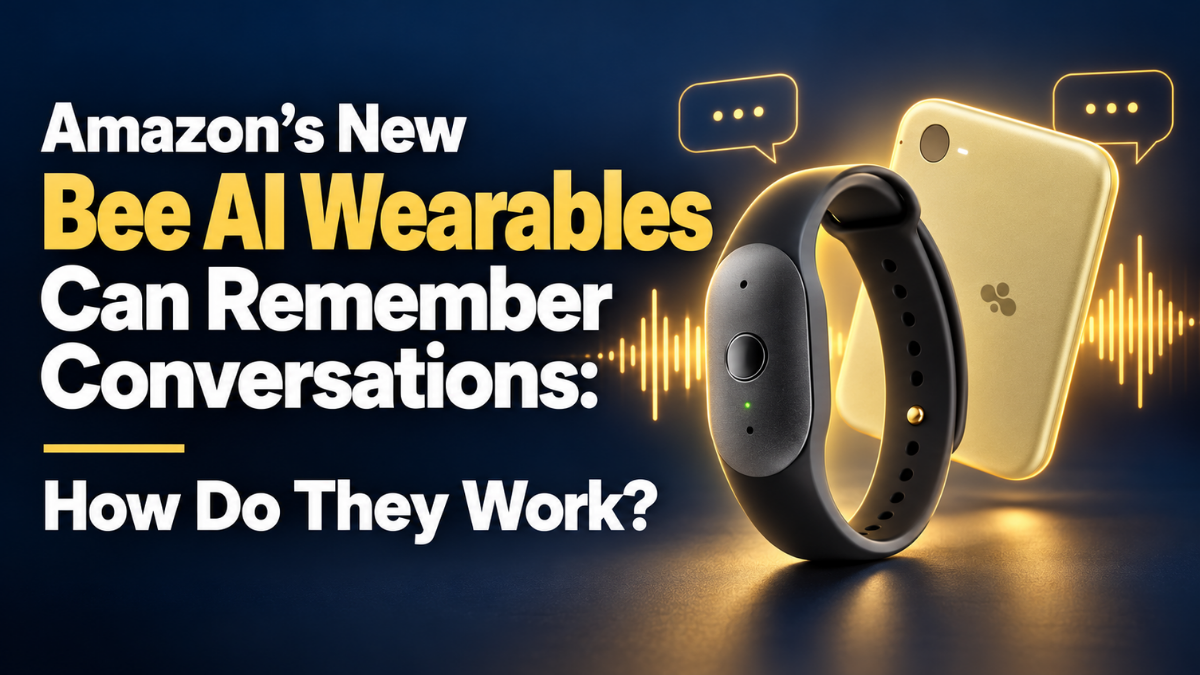
The Amazon Bee AI wearable range now includes two new devices: Bee Frontier, a wristband that can also clip onto clothing, and Bee Eclipse, a slim magnetic attachment for smartphones. Announced on 15 October 2026, both products use artificial intelligence to process conversations and help users recall useful information later.
However, Bee does not remember every word perfectly, and it is not designed to preserve a permanent library of audio recordings. Amazon says its system processes captured audio in real time, deletes the original sound and protects the resulting transcripts and insights through encryption.
That distinction is particularly important as AI wearables become more personal. While the technology could help people organise meetings, appointments and everyday tasks, it also raises questions about recording consent, data privacy and whether people nearby are comfortable having their conversations processed by AI.
What Is the Amazon Bee AI Wearable?
Amazon Bee AI wearable technology is designed to act as a personal memory assistant. Instead of answering only general questions, Bee uses information from conversations and connected services to help users remember commitments, identify useful details and organise their day.
Bee originally developed its technology as an independent AI startup before Amazon announced plans to acquire the company in July 2025. Following the acquisition, Bee continued developing its wearable assistant, adding features such as calendar connections, personal insights and AI-generated actions.
Amazon’s October 2026 announcement introduced two devices under the Bee brand. Bee Frontier is the next-generation wearable, while Bee Eclipse is a new phone attachment designed for people who want conversation assistance without wearing a separate wristband.
The devices do not rely on a traditional smartwatch display. Instead, they work with Bee’s companion software, where users can review conversation summaries, search previous information and manage supported actions.
This approach reflects a broader shift in artificial intelligence towards assistants that understand personal context rather than responding to isolated prompts. The central idea is that AI becomes more useful when it can help people recall information they have already encountered.
How Does Amazon Bee Remember Conversations?
Bee remembers conversations by converting spoken audio into digital information that AI can analyse. Rather than keeping the original recording as its primary memory, the system creates transcripts, summaries and structured details that users can access afterwards.
When a user activates the device, its microphones capture nearby speech. Bee then uses speech-recognition technology to convert that audio into text, allowing its AI systems to identify relevant topics, commitments and other information.
The resulting text provides the foundation for Bee’s conversation memory. Its software can generate summaries, identify potential follow-up tasks and organise information so users can search for it later. For example, imagine discussing a project deadline with a colleague. Bee could turn the supported conversation into a summary and identify the deadline as an important detail, helping the user retrieve it without manually reviewing a recording.
Amazon says the original audio is deleted after processing. However, the resulting transcripts and insights can remain available according to the user’s memory settings and subscription plan, meaning deleting audio is not the same as deleting all information derived from a conversation.
Can Bee Search Previous Conversations?
Yes. Bee’s official product information describes searchable conversation summaries and memories, allowing users to return to previously captured information.
Instead of remembering exactly when someone mentioned an appointment, users can search their conversation history for relevant details. The usefulness of those results depends on whether the device captured the conversation successfully and whether its transcription accurately represented what was said.
Bee Pro also includes a personal chat assistant that can help users interact with their stored information. This makes the product closer to a searchable personal knowledge system than a conventional digital voice recorder.
What Can Amazon Bee AI Actually Do?
The main benefit of Bee is its ability to organise everyday information without requiring constant typing. Amazon describes features that turn supported conversations into summaries, recaps and useful insights, with additional capabilities available through Bee Pro.
For professionals, the device could help organise meeting discussions and identify potential follow-up actions. A user might review a conversation summary after speaking with a colleague, then use supported integrations to prepare an email or calendar entry. Students could also find the concept useful when reviewing permitted recordings of lectures or study discussions. However, universities and lecturers may have restrictions on recording, and AI-generated notes should not replace checking important information against original teaching materials.

Outside work and education, Bee could help users remember plans made with friends, shopping-related discussions or tasks mentioned during a busy day. The device is designed to reduce the need to interrupt conversations simply to write something down. The optional Bee Pro subscription expands these functions through suggested to-dos, daily memories, a personal assistant and third-party integrations. Amazon has also introduced connections with Alexa+ and Amazon.com, allowing supported information to move into other parts of its ecosystem when users enable those services.
These features do not mean Bee can independently complete every task or make every decision correctly. Users still need to review important details, check generated actions and decide which connected services should receive their information.
Does Amazon Bee Record Everything You Say?
No, not automatically in every situation. Amazon’s current Bee Frontier documentation describes a physical button that users press to start or stop capture, along with a green LED indicator showing when the device is active.
This means Bee is not simply an invisible microphone that records every conversation without any user control. However, once activated, it can capture surrounding speech during a recording session, so people nearby may still have privacy concerns.
Bee’s documentation also describes configurable behaviour for stopping capture after a period of silence. The exact experience can depend on the device, its settings and how the user chooses to operate it. The Frontier includes two microphones and noise-filtering technology intended to improve speech capture. Its physical design allows people to wear it on their wrist or attach it to clothing, making it convenient to carry throughout the day.
Bee Eclipse takes a different approach by attaching magnetically to a compatible smartphone. Its design is intended to support personal and professional conversations, including phone-related use cases, although recording calls requires particular care over consent and applicable rules. The presence of an indicator light does not guarantee everyone nearby will notice it or understand what it means. Users should explain when they intend to capture conversations, especially in workplaces, classrooms or private settings.
How Accurate Is Amazon Bee’s Conversation Memory?
Bee’s usefulness depends heavily on the accuracy of its speech recognition and AI-generated summaries. Although the company promotes advanced transcription and support for more than 40 languages, that does not establish perfect performance in every environment.
Background noise, overlapping voices, unfamiliar names and unclear speech can all make transcription more difficult. Even when the system recognises most words correctly, an AI-generated summary might omit context or place too much emphasis on a minor detail.
This becomes particularly important when users rely on Bee for meeting decisions, deadlines or financial information. A summary can help someone remember a discussion, but it should not automatically become the definitive record of what participants agreed.
Another limitation is the absence of saved original audio under Amazon’s stated privacy design. Because Bee discards audio after processing, users may not be able to replay the original conversation to resolve a disputed transcription. For everyday reminders, that trade-off may be acceptable. For legal discussions, formal interviews or situations requiring an exact record, a conventional recording and transcription workflow may be more appropriate, subject to consent and relevant rules.
Amazon Bee Privacy: What Happens to Your Conversations?
Privacy is one of the most important questions surrounding Amazon’s new wearable devices. A system designed to remember personal conversations may encounter information about relationships, workplaces, appointments and other sensitive subjects.
Amazon says Bee uses a security architecture called Bee Private Compute. According to the company’s September 2026 explanation, the system processes captured audio in real time and discards it, while protecting the resulting transcripts and summaries using encryption keys controlled by the user’s device.
Amazon also says its isolated processing environment prevents the company and outside providers from accessing users’ private conversation content by default. These are the company’s documented security claims, rather than a guarantee that every possible privacy or security risk has been eliminated.
Users can delete transcripts and summaries, revoke supported permissions and manage their account information. Bee’s account documentation also explains how to delete an account and its associated conversations and personal context. However, a device can protect stored data while still creating privacy concerns during collection. Other people may not expect a conversation to become a searchable AI memory, even if the original audio is deleted.
Workplaces may also restrict recording confidential meetings, customer conversations or commercially sensitive information. In the UK, relevant data protection and privacy requirements depend on the circumstances, so users should not assume that wearing Bee automatically gives them permission to record other people. The most sensible approach is to use Bee transparently. Users should understand the recording indicator, inform other participants where appropriate and avoid capturing conversations when consent or confidentiality is uncertain.
Amazon Bee Price, Subscription and Availability
Amazon has confirmed that Bee Frontier costs $74.99 in the United States. The device is available in Onyx, Lavender and Sage, and the company describes it as suitable for both wrist-worn and clip-on use.
Bee Eclipse starts at $99.99 and is expected to become available after the initial announcement. Amazon has listed Silver, Midnight, Honey and Blush as its colour options, but has not confirmed a precise general release date.
The standard Bee experience includes conversation summaries, recaps and 14-day memory without an additional subscription fee. Users who want expanded capabilities can subscribe to Bee Pro for $11.99 per month, with Amazon offering a 30-day trial to new customers.
Bee Pro includes unlimited recent conversation summaries, daily memories, suggested to-dos, a personal chat assistant and additional integrations. The subscription also provides access to supported Amazon.com and Alexa+ connections, along with Bee’s desktop application.
Bee Frontier offers more than seven days of battery life according to its official specifications, along with IP67-rated water resistance. Bee Eclipse is advertised with a battery life of approximately three weeks, although real-world endurance will depend on usage.
Is Amazon Bee Available in the UK?
Amazon’s October 2026 announcement confirms US pricing and availability for Bee Frontier. However, it does not establish a UK launch date or official UK retail price for the new devices.
UK customers should therefore avoid assuming that the products are immediately available through Amazon UK. Importing a device would also require checking regional support, warranty arrangements, app compatibility and access to subscription features.
The Bee companion app supports iOS and Android according to the current Frontier product information. However, users should verify the specific device and software requirements before purchasing, particularly for the upcoming Eclipse model.
Amazon Bee vs Alexa: What’s the Difference?
Bee and Alexa serve different purposes, even though both now belong to Amazon’s wider AI ecosystem. Alexa primarily helps users interact with supported devices, information and services through voice commands, while Bee focuses on capturing and organising personal context.
A traditional Alexa interaction might involve asking for the weather, setting a timer or controlling compatible smart-home accessories. Bee instead aims to help users remember information from conversations that have already taken place.
Amazon’s upgraded Alexa+ assistant adds more conversational and task-oriented capabilities. The company now allows supported Bee information to connect with Alexa+, enabling users to request summaries or to-dos through compatible Alexa experiences.
For example, someone who captured a meeting using Bee may later be able to ask Alexa about relevant follow-up tasks after connecting the services. However, access depends on the user’s permissions, subscription and supported integrations.
The distinction is particularly interesting because Amazon is moving towards assistants that understand more of a person’s daily activities. Instead of treating each voice request as a separate interaction, the company wants its services to provide more personalised assistance based on information users choose to share.
Amazon Bee vs Other AI Wearables
Bee is entering a growing market of devices that use artificial intelligence to capture and organise information. However, different products take different approaches to recording, transcription and personal assistance.
Some devices focus primarily on meeting notes, while others attempt to build a broader understanding of a user’s activities. The best option depends on whether someone needs formal transcripts, hands-free convenience or a personal memory assistant.
| Feature | Bee Frontier | Bee Eclipse | Plaud Note |
|---|---|---|---|
| Main purpose | Personal conversation memory | Conversation and phone-related assistance | Meeting and voice-note recording |
| Format | Wristband or clothing clip | Magnetic phone attachment | Slim recording device |
| AI summaries | Yes | Yes | Yes |
| Original audio storage | Amazon says audio is discarded | Amazon says audio is discarded | Supports saved recordings |
| Battery | More than 7 days | Around 3 weeks | Varies by model |
| Starting US price | $74.99 | $99.99 | Varies by model |
| Subscription | Optional Bee Pro | Optional Bee Pro | Plan-dependent |
| Availability | Available in US | Coming soon | Depends on model and region |
The biggest difference concerns how users want to preserve information. Bee prioritises AI-generated memories without retaining original audio, while a recording-focused device such as Plaud Note may better suit people who need access to source recordings.
However, retaining audio also creates different storage, security and consent responsibilities. Readers should examine each manufacturer’s current policies rather than assuming that all AI note-taking devices handle information in the same way.
Who Would Actually Benefit From Amazon Bee?
Bee could appeal to professionals who regularly move between meetings and informal discussions. Instead of relying entirely on handwritten notes, they could review summaries and identify potential follow-up actions after supported conversations.
Students may also appreciate a wearable assistant for organising study discussions and permitted lecture recordings. However, they would still need to verify important facts and follow institutional rules about recording.

People managing busy schedules could use Bee to remember appointments, plans and everyday commitments. Its potential value lies in reducing small organisational tasks rather than replacing a calendar, notebook or personal judgement. The device may be less useful for people who rarely need conversation summaries or who prefer not to capture speech throughout the day. It also introduces another gadget to charge, configure and manage, even if its battery lasts considerably longer than a typical smartwatch.
Is Amazon Bee Worth Considering?
Bee Frontier’s $74.99 price makes it relatively accessible compared with some premium AI gadgets. However, the optional subscription changes the long-term cost for users who want unlimited recent summaries, advanced integrations and other Pro features.
The technology’s main attraction is convenience. Turning supported conversations into organised information could help users remember tasks without interrupting discussions to take notes.
Nevertheless, its value depends on transcription quality, reliable connectivity, privacy expectations and how often someone actually needs the information it captures. Amazon’s documented security controls are encouraging, but users should still think carefully about the conversations they allow the device to process.
For UK readers, availability remains another practical limitation. Until Amazon confirms local pricing and distribution, the new Bee range is more useful as a preview of where personal AI wearables are heading than as an immediate buying recommendation.
Final Thoughts
Amazon’s new Bee AI wearables show how personal assistants are moving beyond screens and smart speakers. Bee Frontier and Bee Eclipse aim to turn supported conversations into summaries, reminders and searchable memories, helping users retrieve information without keeping traditional audio recordings.
The technology could prove useful for meetings, everyday planning and personal productivity, especially as Amazon expands connections with Alexa+ and other services. However, AI-generated memories are not guaranteed to be complete or accurate, and recording people nearby introduces responsibilities that cannot be solved through encryption alone.
For Mobile Verse readers following AI wearable news, the most important question is whether the convenience outweighs the cost and privacy considerations. Bee offers an interesting approach to personal AI, but its real value will depend on how reliably it helps people remember what matters.
Frequently Asked Questions
What is Amazon Bee AI?
Amazon Bee AI is a personal assistant system that uses wearable devices to process supported conversations and create summaries, reminders and searchable memories. Amazon introduced the Bee Frontier wristband and Bee Eclipse phone attachment in October 2026, following its acquisition of the original Bee startup in 2025.
How does Amazon Bee remember conversations?
Bee captures audio when recording is active and converts speech into text using speech-recognition technology. Its AI then identifies useful details and generates summaries or memories that users can review later. Amazon says the original audio is deleted after processing, while encrypted text-based information can remain available.
Does Amazon Bee record everything?
Bee does not automatically record every sound at all times. Amazon’s current devices use physical recording controls and visible indicators, although they can capture surrounding conversations while a session is active. Users should check their settings and explain recording to other participants where appropriate.
Does Amazon Bee store audio recordings?
Amazon says Bee Frontier and Bee Eclipse process audio in real time and delete it rather than storing permanent recordings. However, the system retains encrypted transcripts, summaries and related insights according to the user’s settings. Users can delete supported conversation data through Bee’s controls.
How much does Amazon Bee cost?
Bee Frontier costs $74.99 in the United States, while Bee Eclipse starts at $99.99 and is expected to become available soon. The basic service includes summaries and 14-day memory, while Bee Pro costs $11.99 per month for expanded features.
Is Amazon Bee available in the UK?
Amazon has confirmed US availability for Bee Frontier but has not announced an official UK release date or UK retail price for the new devices. UK buyers should wait for regional availability details before assuming the product and its subscription features are fully supported locally.
Does Amazon Bee work with Android and iPhone?
Bee’s official Frontier product information confirms support for companion apps on iOS and Android. However, specific operating-system requirements and feature availability may vary by device. Buyers should check the current compatibility information before ordering, especially for the upcoming Bee Eclipse.
Is Amazon Bee different from Alexa?
Yes. Bee focuses on turning conversations into personal memories and useful information, while Alexa primarily responds to voice requests and helps control supported devices and services. Amazon now offers Bee connections with Alexa+, allowing eligible users to access selected Bee information through supported Alexa experiences.