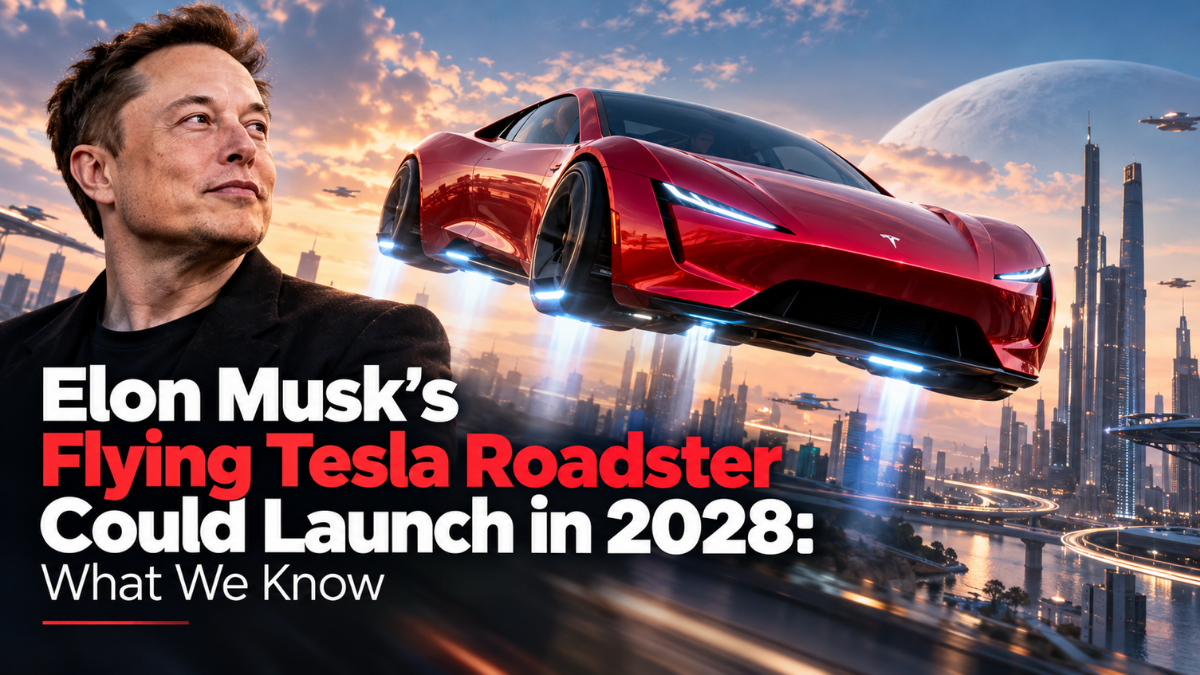
Elon Musk’s Flying Tesla Roadster Could Launch in 2028: What We Know
 By Inflix
 Tesla has unveiled a redesigned Roadster that takes electric sports car performance into unusual territory. During an October 2026 demonstration, the company showed a prototype driving upside down, performing short airborne manoeuvres and landing using propulsion technology developed with SpaceX.
The Tesla Roadster 2028 is now targeting production in 2028, nearly eleven years after Elon Musk first introduced the second-generation concept. The latest demonstration suggests that Tesla wants the Roadster to become more than another high-performance electric vehicle, although its unusual capabilities still face major engineering and regulatory questions.
However, there is an important distinction between a car performing controlled jumps and a vehicle capable of sustained flight. Tesla has not demonstrated that the Roadster can travel through the air like an aircraft, and the company has not confirmed when customers will receive production vehicles with these features.
Elon Musk’s Flying Tesla Roadster: What Happened at the Reveal?
Tesla presented its redesigned Roadster on 15 October 2026 at SpaceX’s facility in McGregor, Texas. The demonstration involved Elon Musk, Tesla design chief Franz von Holzhausen and engineering executive Lars Moravy, who showcased the company’s approach to combining electric vehicle performance with rocket-inspired technology.
The most dramatic moment involved a specially designed curved ramp. The Roadster climbed the structure, travelled upside down using a suction-based system and then launched into the air. Thrusters helped control its movement before the prototype returned to the ground.
Tesla also demonstrated another airborne manoeuvre in which the Roadster jumped over a line-up of vehicles. The display included familiar models such as the Cybertruck, Cybercab, Model Y and Model 3, illustrating how far the prototype could move beyond ordinary road driving.
According to reporting from MotorTrend and other automotive publications, Tesla demonstrated acceleration from 0 to 60 mph in approximately 0.81 seconds. Although the result attracted considerable attention, it remains a manufacturer demonstration rather than an independently verified performance figure for a customer-ready vehicle. The unveiling marks an important milestone for Tesla electric vehicles, particularly because the Roadster project has experienced repeated delays. Nevertheless, Tesla still needs to demonstrate that its technology can operate reliably outside a controlled presentation.
Can the Tesla Roadster Really Fly?
The new Roadster can perform short airborne manoeuvres, but calling it a fully functioning flying car would be misleading. Tesla demonstrated that the prototype could leave the ground, control its orientation and land using specialised propulsion equipment.
Traditional aircraft must generate enough lift or thrust to remain airborne for an extended period. Tesla has not demonstrated that the Roadster can maintain controlled flight, travel meaningful distances through the air or operate as an alternative to an aeroplane.
Instead, the prototype uses short bursts of force to change its movement. These bursts can help lift the vehicle, rotate it or support a controlled landing, but they do not establish that the car can hover indefinitely.
This distinction matters because the phrase Elon Musk flying car creates expectations about practical transportation. For now, the Roadster remains an experimental electric sports car with limited airborne capabilities rather than a commercially proven flying vehicle.
How Do the Tesla Roadster’s SpaceX Thrusters Work?
One of the Roadster’s most unusual features is its use of cold-gas thrusters. These devices produce force by releasing highly compressed gas through carefully positioned nozzles, allowing engineers to influence the vehicle’s movement without relying entirely on its tyres.
Unlike conventional rocket engines, cold-gas thrusters do not burn fuel to create thrust. Instead, gas stored under pressure escapes through a nozzle, producing a reaction force that pushes the vehicle in the opposite direction.
The principle comes from established aerospace engineering, where similar systems help control the orientation of spacecraft. Tesla’s approach adapts this concept to an electric sports car, creating a connection between automotive performance and SpaceX technology.
Reports from the demonstration describe a system with ten thrusters and approximately 600 litres of compressed-gas storage. MotorTrend reported the use of nitrogen, although Tesla has not published a complete production specification covering tank pressure, nozzle performance or system durability.
The direction of each thruster determines how it influences the vehicle. Rear-facing jets can assist forward acceleration, while differently positioned nozzles may help generate upward force or control rotation during an airborne movement.
However, compressed gas is a limited resource. Each activation reduces the available stored pressure, meaning the system cannot deliver continuous thrust without replenishing its supply. Tesla has not confirmed how frequently a production Roadster could perform these manoeuvres before the system needs recharging.
How Did the Roadster Drive Upside Down?
The inverted driving demonstration relied on a separate suction-based system rather than the cold-gas thrusters alone. Powerful fans generated a pressure difference that helped keep the tyres pressed against the specially designed ramp.
This technology creates additional downforce, helping the vehicle maintain contact with the driving surface even when that surface curves overhead. The principle differs from conventional aerodynamic downforce, which typically becomes more effective as a vehicle moves faster.
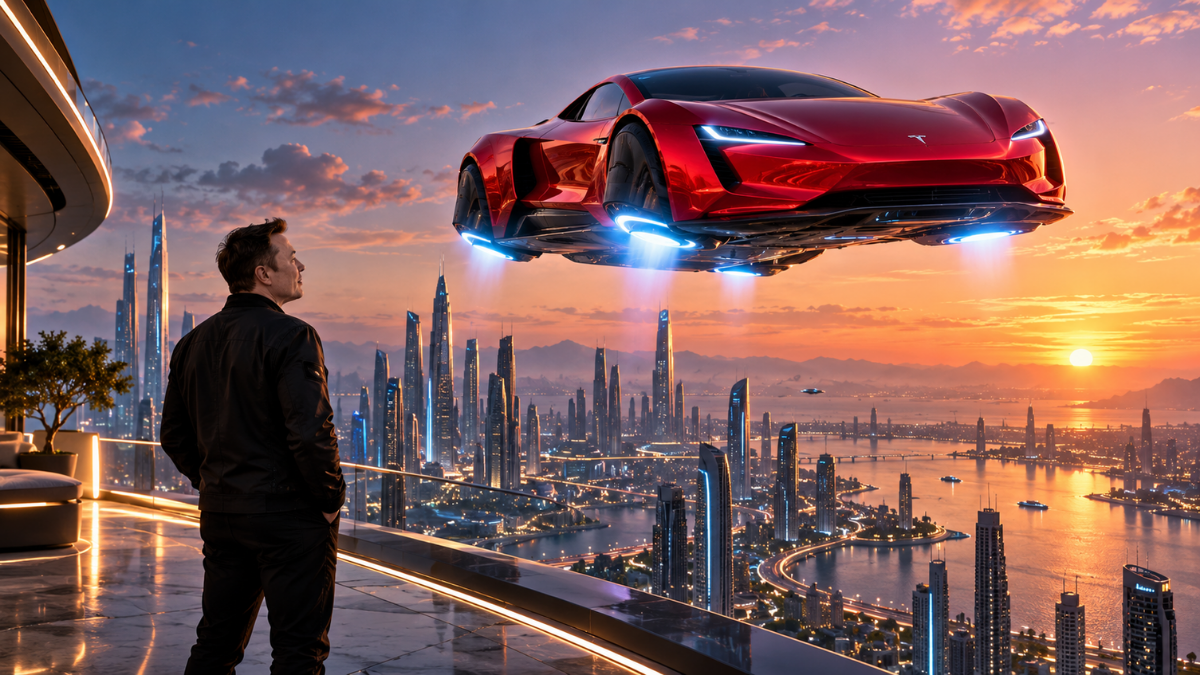
Tesla’s demonstration combined suction, propulsion and vehicle control systems to produce the unusual sequence. However, the specially prepared ramp and controlled conditions mean the result should not be treated as evidence that an ordinary Roadster could safely drive upside down on public infrastructure.
Tesla Roadster 2028: Expected Release Date and Production Timeline
Tesla currently targets 2028 for the start of Roadster production. That timeline follows years of uncertainty surrounding the second-generation model, which the company originally introduced in November 2017.
At the original unveiling, Tesla outlined ambitious performance figures and suggested the vehicle would reach production much sooner. However, manufacturing priorities, engineering changes and other company projects repeatedly pushed the Roadster further into the future.
The October 2026 demonstration provides more evidence of development progress than earlier promises alone. Tesla has now publicly shown a redesigned prototype performing unusual manoeuvres, although significant work may remain before the company can manufacture and deliver customer vehicles.
A production target is not the same as a confirmed release date. Even if Tesla begins manufacturing in 2028, the first deliveries could follow later, and different Roadster configurations may become available at different times.
For readers following future technology, the next important milestone will be a production-ready Roadster with final specifications, verified performance and a confirmed customer delivery schedule.
Tesla Roadster Performance: How Fast Is It?
Tesla’s acceleration demonstration was one of the biggest talking points of the unveiling. Automotive reporting described a run from 0 to 60 mph in approximately 0.81 seconds, an extraordinary result for a vehicle designed around road-car architecture.
Conventional electric sports cars rely on their motors and tyres to transfer power to the road. However, tyres have limited grip, and that limitation becomes particularly important when engineers attempt extremely rapid acceleration.
Cold-gas thrusters offer another source of forward force. By directing compressed gas backwards, the vehicle can generate additional thrust without depending entirely on the contact between its tyres and the road. Tesla has also indicated a potential top speed exceeding 230 mph. However, independent testers have not established that a production-ready Roadster can achieve this figure, and the final performance specifications may differ between variants.
The distinction between demonstration results and customer performance is essential. Tesla still needs to show how the propulsion system behaves during repeated use, how consistently the vehicle accelerates and whether production models can reproduce the reported figures.
Tesla Roadster Design and Specifications
The redesigned Roadster adopts a sharper and more aggressive appearance than the original 2017 concept. Its low body, angular surfaces and performance-focused proportions reflect Tesla’s effort to create a distinctive electric supercar.
Tesla has reportedly drawn inspiration from advanced aircraft when developing the design. However, visual similarities to aerospace technology do not mean the Roadster uses the same engineering systems as a fighter aircraft.
The company has introduced three configurations known as Performance, Thrust and Rocket. Each version targets a different level of performance, with the most advanced model incorporating the full cold-gas propulsion arrangement. The Performance and Thrust versions are designed around two-seat layouts, while the Rocket configuration uses a single-seat arrangement to accommodate additional equipment. The exact production specifications, including vehicle weight, battery capacity and charging performance, remain incomplete.
Tesla has indicated an estimated driving range of around 300 miles, but independent testing has not established the real-world range of the redesigned vehicle. Energy consumption could also differ substantially between versions, particularly those carrying additional propulsion hardware.
Tesla Roadster Performance, Thrust and Rocket Compared
| Feature | Performance | Thrust | Rocket |
|---|---|---|---|
| Main purpose | Road-focused performance | Enhanced acceleration | Extreme performance and airborne manoeuvres |
| Seating | Two | Two | One |
| Thruster arrangement | No full airborne system announced | Rear cold-gas propulsion | Ten cold-gas thrusters |
| Flying capability | Not demonstrated | Limited capabilities remain unclear | Short airborne manoeuvres demonstrated |
| Estimated driving range | Around 300 miles | Around 300 miles | Around 300 miles |
| Reported reservation | $50,000 | $250,000 | Invitation only |
| Production target | 2028 | 2028 | Exact availability unconfirmed |
These details reflect the reported configurations rather than final production specifications. Tesla has not confirmed that every capability demonstrated on the prototype will appear unchanged in customer vehicles.
Tesla Roadster Price: How Much Could the Flying Version Cost?
Tesla has not announced final retail prices for the redesigned Roadster range. However, reporting following the unveiling describes different reservation arrangements for the Performance, Thrust and Rocket configurations.
The Performance version reportedly requires a $50,000 reservation payment, while the Thrust version carries a $250,000 reservation requirement. The Rocket model is described as invitation-only, reflecting its more specialised engineering and limited expected audience.
Importantly, these amounts are reservation payments rather than confirmed purchase prices. The final vehicle cost may depend on configuration, production expenses and any additional equipment Tesla offers when orders become available.
Tesla has also not confirmed official UK pricing for the redesigned Roadster. Buyers should avoid treating speculative conversions or estimated prices circulating online as confirmed figures. Anyone considering a reservation should review Tesla’s current terms, including refund conditions and delivery commitments. The company’s history of Roadster delays makes those details particularly important.
Is the Flying Tesla Roadster Road Legal?
Public-road legality remains one of the biggest unanswered questions about the flying Roadster. A vehicle that can operate on ordinary roads does not automatically receive permission to perform airborne manoeuvres around other road users.
Regulators would need to examine the safety of the compressed-gas system, vehicle stability and the potential consequences of an unintended thruster activation. High-pressure storage equipment and unusually powerful propulsion systems introduce additional engineering requirements.
The airborne capabilities could also raise questions about aviation regulation, depending on how authorities classify the system. However, Tesla has not established that the Roadster qualifies as a conventional aircraft or that its flying functions have received approval for public use.
Even if Tesla secures road approval for a production Roadster, that would not necessarily authorise drivers to perform jumps or airborne rotations. Ordinary road certification and permission to use specialised propulsion equipment are separate issues. The safety challenge extends beyond the driver. A malfunction or uncontrolled manoeuvre could affect nearby vehicles, pedestrians and infrastructure, making regulatory approval an important part of any future commercial release.
Tesla Roadster vs Traditional Flying Cars: What’s Different?
The Roadster’s airborne demonstration creates an obvious comparison with flying-car projects. However, most conventional flying-car concepts aim to transport passengers through the air for meaningful distances, while Tesla’s system currently focuses on short movements and extreme performance.
For example, Alef Aeronautics has developed a vehicle concept intended to combine road travel with vertical-flight capabilities. Tesla’s Roadster takes a different approach by adding specialised propulsion to an electric sports car rather than designing a vehicle primarily around airborne transportation.
A traditional flying car must address sustained lift, flight control, navigation and aviation safety requirements. The Roadster’s demonstrated capabilities instead involve short bursts of thrust, controlled rotation and landing within a prepared environment. These differences make direct comparisons difficult. Tesla may have demonstrated an impressive automotive engineering achievement, but it has not shown a practical replacement for an aircraft or a fully operational urban flying-car service.
Why Tesla’s Flying Roadster Matters for Electric Car Technology
Tesla’s demonstration highlights how automotive engineers can experiment with systems normally associated with aerospace technology. Cold-gas propulsion, suction-generated downforce and advanced vehicle control represent a different approach to improving performance.
Most high-performance electric cars focus on more powerful motors, better batteries, improved aerodynamics and sophisticated traction systems. Tesla is exploring an additional source of force that could influence acceleration and vehicle movement beyond conventional tyre grip.
This approach could encourage further experimentation within electric car technology, particularly in specialist motorsport and experimental vehicle development. However, wider applications remain uncertain, and Tesla has not announced that its thruster system will become a feature of ordinary consumer vehicles. The Roadster also serves a strategic purpose for Tesla. As the company expands into robotics and autonomous driving, a dramatic performance car provides an opportunity to highlight its engineering ambitions and attract attention to the brand.
Nevertheless, a successful prototype does not guarantee commercial success. Tesla must demonstrate reliable manufacturing, manageable maintenance costs, consistent performance and compliance with applicable safety requirements.
Should You Wait for the Tesla Roadster 2028?
For automotive enthusiasts, the redesigned Roadster is undoubtedly an unusual project. Its combination of electric performance and aerospace-inspired propulsion makes it different from most sports cars currently available.
However, anyone considering a purchase should remember that Tesla has not confirmed final prices or customer delivery dates. The company has also not demonstrated that production vehicles will reproduce every capability shown during the unveiling. Buyers primarily interested in a fast electric sports car may find more practical options among established production models. Those vehicles offer published specifications, existing service networks and performance that independent reviewers can evaluate.
The Roadster may eventually become a remarkable collector’s car, particularly in its most advanced configuration. For now, waiting for production specifications and independent testing is a more reliable approach than making purchasing decisions based entirely on the demonstration.
Final Thoughts
Elon Musk’s redesigned Tesla Roadster has delivered one of the most unusual electric vehicle demonstrations of 2026. Its SpaceX-derived propulsion system allowed a prototype to perform short airborne manoeuvres, while Tesla also showcased remarkable acceleration and an unconventional inverted-driving sequence.
However, the Tesla Roadster 2028 remains a future production project rather than a commercially available flying car. The 2028 timeline is a target, and Tesla has not confirmed final pricing, customer deliveries or regulatory approval for the prototype’s airborne features.
The technology shows considerable ambition, but the real challenge begins after the demonstration. Tesla must now prove that its redesigned Roadster can move from an extraordinary prototype to a reliable, safe and commercially viable production vehicle.
Frequently Asked Questions
Can Elon Musk’s new Tesla Roadster really fly?
Tesla demonstrated a Roadster prototype performing short airborne manoeuvres using cold-gas thrusters. The vehicle could leave the ground, rotate and land under controlled conditions. However, Tesla has not demonstrated sustained flight, so the Roadster should not be considered a conventional flying car or aircraft.
When will the Tesla Roadster launch?
Tesla currently targets 2028 for the start of Roadster production. However, the company has not confirmed a guaranteed customer delivery date. The project has experienced several delays since its original 2017 announcement, and different versions may become available at different times.
How do the Tesla Roadster’s SpaceX thrusters work?
The thrusters release compressed gas through strategically positioned nozzles to produce force. Depending on their orientation, the jets can assist acceleration, influence vehicle movement or support short airborne manoeuvres. Tesla has demonstrated the technology, but complete production specifications remain unavailable.
How fast is the new Tesla Roadster?
Tesla reportedly demonstrated acceleration from 0 to 60 mph in approximately 0.81 seconds and indicated a potential top speed exceeding 230 mph. However, these figures have not been independently verified on a production vehicle, and performance may vary between Roadster configurations.
How much will the 2028 Tesla Roadster cost?
Tesla has not confirmed final purchase prices for the redesigned Roadster. Reported reservation payments include $50,000 for the Performance version and $250,000 for Thrust, while Rocket is invitation-only. These amounts should not be confused with the eventual retail prices.
Is the flying Tesla Roadster legal on public roads?
Tesla has not confirmed regulatory approval for using its airborne propulsion features on public roads. Even if a production Roadster receives approval for ordinary driving, that would not automatically permit jumps, airborne rotations or other demonstration-style manoeuvres in traffic.
Can you reserve the new Tesla Roadster?
Tesla has reportedly introduced reservation arrangements for the Performance and Thrust versions, while the Rocket model is invitation-only. Buyers should verify current availability, payment terms and refund conditions directly through Tesla before making any financial commitment.
Will the production Tesla Roadster have flying capabilities?
Tesla intends to develop specialised propulsion features for its higher-performance Roadster variants. However, it has not confirmed that production vehicles will reproduce every airborne manoeuvre demonstrated by the prototype. Final capabilities will depend on engineering, safety testing and regulatory approval.